
Why Don't Electric Cars Have Solar Panels?
Author: Steve Fairless
Originally Published: 8th June 2024 · Updated: 28th August 2026
Most electric cars do not use roof-mounted solar as their main energy source because a car has far too little sun-facing surface area to collect energy at the rate needed for everyday driving. Vehicle-integrated photovoltaics can add useful range, reduce external charging and power auxiliary loads, but today it is normally a supplement to plug-in charging rather than a replacement for it.
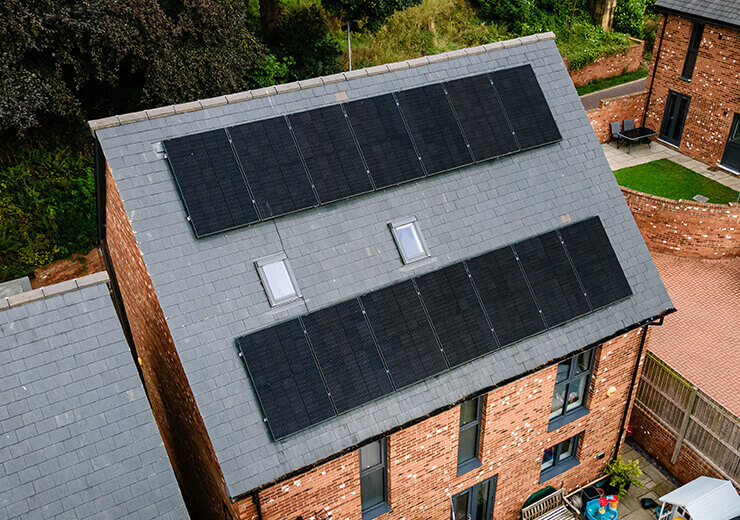
At Sustainable Energy Engineering, we see the physics from the other direction every day: a house roof can accommodate several kilowatts of PV, stay in one location, use an optimised mounting angle and feed both the home and an EV charger. A passenger car has perhaps a fraction of that usable area, changes direction constantly, parks in shade and must carry its solar system through every mile it drives.
Updated: 28th August 2026 using the latest IEA PVPS research on vehicle-integrated photovoltaics (VIPV).
The Short Answer
Solar-powered driving is possible, but the available roof and body area caps the onboard generation. Even very efficient solar cells cannot collect more solar energy than actually falls on the car. Current VIPV research therefore focuses on range extension, reduced charging frequency and auxiliary energy rather than assuming a normal family EV can live indefinitely without plugging in.
The Real Limitation Is Energy Collection Area
A modern EV can be remarkably efficient, but moving a one- to two-tonne vehicle still requires substantial energy. IEA PVPS notes that around 14 kWh/100 km is considered very efficient for a current mass-market EV, while a purpose-optimised solar vehicle can be closer to 11 kWh/100 km.
Now compare that with the roof. Even if a car carried roughly 1 kWp of high-efficiency PV — already an ambitious amount for many normal passenger vehicles — that array only produces its rated power under standard test conditions. For most of the day it will be below that level, and during darkness it produces nothing.
A Worked Example Shows Why the Idea Is Useful — But Limited
Suppose a vehicle has 0.8 kWp of integrated PV and, over a good day, receives the equivalent of 3 full-output hours after orientation and weather are considered. That is 2.4 kWh before system losses. At a very efficient 14 kWh/100 km, 2.0 usable kWh would represent roughly 14 km of driving.
That is valuable as free range accumulated while parked, but it is not comparable with plugging a 60 kWh battery into a 7 kW home charger overnight.
This Is an Illustration, Not a UK Solar-Car Forecast
A moving vehicle has changing orientation, curved panels, partial shade, dirt, temperature variation and parked locations that may be indoors or under trees. Real VIPV yield is highly location- and use-dependent.
Current Research Shows the Best-Case Potential Can Still Be Impressive
IEA PVPS Task 17 provides a useful reference. Its 2025 fact sheet used the highly optimised Lightyear 0 as an example: approximately 0.981–1.05 kWp of vehicle-integrated PV, energy consumption around 10.9 kWh/100 km, and modelling indicating about 4,500 solar kilometres per year in Paris, depending on architecture and with shading losses estimated at 30%.
That does not mean a conventional SUV with a small solar roof will add 4,500 km. The Lightyear example matters precisely because it shows how strongly vehicle efficiency, PV area and aerodynamic design influence the result.
What the Latest VIPV Evidence Says
- Mass-market efficiency reference: IEA PVPS cites about 14 kWh/100 km as a very efficient current EV benchmark.
- Optimised solar EV: the same fact sheet uses about 10.9 kWh/100 km for Lightyear 0.
- Solar roof size: roughly 1 kWp in the Lightyear example.
- Modelled solar contribution: around 4,500 km/year in Paris for that highly optimised architecture.
- Research direction: current 2026 work focuses on curvature, weight, aesthetics, manufacturing, energy yield and how parked generation can offset added mass.
Why Cars Are Harder Than Rooftops
| Design factor | Electric car | Home roof |
|---|---|---|
| Usable area | Limited to roof, bonnet and selected body surfaces | Often tens of square metres |
| Orientation | Changes whenever the car turns or parks | Fixed and known at design stage |
| Shade | Buildings, trees, car parks and other vehicles | Can be surveyed and modelled before installation |
| Curvature | Cells/modules may need to follow aerodynamic surfaces | Flat framed modules on a designed mounting plane |
| Weight sensitivity | Every kilogram is carried during driving | Structural loading matters, but the array does not move |
| Maintenance | Stone chips, body repairs, washing and collision repair | Dedicated rooftop equipment with established service practices |
Curved Body Panels Create Electrical and Manufacturing Challenges
The 2026 IEA PVPS technology report highlights a problem that rooftop installers rarely face: vehicle PV often has to follow curved surfaces. Bending cells and modules affects mechanical design, manufacturing and reliability. Different parts of the body can also receive very different irradiance at the same time.
That creates mismatch. A roof section may be in full sun while the bonnet is shaded or at a poor angle. Vehicle power electronics have to extract useful energy from these different surfaces without allowing one section to drag down the others.
Aesthetics Matter More on a Car
Consumers expect modern vehicle bodywork to have consistent colour, gloss and shape. IEA PVPS identifies aesthetics and colour reproducibility as significant commercial issues for VIPV. Tinting or colouring solar surfaces can reduce the light reaching the cells, so designers are balancing appearance against energy yield.
A rooftop panel can look recognisably like a solar module. A premium vehicle maker may want the PV to disappear visually into the bodywork.
Weight Is More Complicated Than “Solar Panels Are Heavy”
The original version of this article treated extra panel weight as a simple reason solar cars do not work. That is too crude. Modern VIPV uses lightweight materials, and the 2026 IEA report specifically considers whether the energy generated while parked can offset the energy penalty caused by added system mass.
The correct engineering question is therefore net benefit: how much additional energy does the PV system create over its life compared with the extra energy needed to carry and manufacture it?
Cars Are Often Parked in the Worst Solar Locations
A house array is intentionally placed where sunlight is expected. A car is parked where life requires: a garage, multi-storey car park, shaded street, office bay, supermarket canopy or tree-lined driveway.
This random parking behaviour is a major reason real yield can differ from brochure assumptions. VIPV works best for vehicles that spend meaningful time outdoors with good sky exposure.
Why a Home Solar Array and EV Charger Usually Make More Sense
A household array can be several times larger than any practical car-mounted array. It can charge the home, a battery and the vehicle across the year. The car then charges when it is convenient rather than only when its own body is in sunlight.
For EV owners, we normally look at a coordinated combination of home solar PV and EV charging. The objective is not to claim the car runs “directly from the sun” every minute; it is to reduce the net grid energy required for household and transport use.
What About Charging the EV Directly From Solar?
Yes, this can be done at home when the charging equipment, inverter/monitoring and energy-management system are configured appropriately. The charger can modulate power based on available surplus rather than drawing the full charging load from the grid.
The key is scale. A 5–8 kWp domestic array has a much larger collection area than a car roof and can deliver meaningful charging power during good conditions.
Solar on the Vehicle Still Has Useful Roles
Range extension
Every solar-generated kWh reduces the amount that must be taken from an external charger.
Auxiliary loads
Ventilation, electronics and low-power vehicle systems can use solar energy without drawing as much from the traction battery.
Vehicles that sit outside
Delivery vans, buses, caravans and specialist vehicles may offer larger surfaces and predictable outdoor dwell time, improving the case for VIPV.
Why the Technology Is More Attractive for Vans, Trucks and Recreational Vehicles
IEA PVPS identifies trucks, buses, recreational vehicles and boats as promising early markets because they can offer larger surfaces, higher auxiliary energy needs and more predictable operating patterns. A refrigerated trailer, for example, can potentially use onboard generation for auxiliary electrical demand even when solar cannot supply traction power.
This is a better way to think about VIPV: not “Can the sun replace the charging network?” but “Where does on-board generation reduce total external energy demand most effectively?”
Could 30%+ Solar Cells Change Everything?
Higher-efficiency cells certainly help because car surface area is fixed. IEA PVPS notes that VIPV may become an outlet for advanced cells above 30% efficiency where users are willing to pay a premium.
But even 30% efficiency does not remove the area limit. It increases the energy captured from the same sunlight; it does not create additional sunlight. A normal car still cannot host the tens of square metres available on a building roof.
Power and Energy Are Different — and This Is Where Many Explanations Go Wrong
An EV can briefly require tens or even hundreds of kilowatts during acceleration. A 1 kWp solar roof can never match that instantaneous traction power. That does not mean the solar roof is useless, because the traction battery buffers energy over time.
The relevant comparison is daily or annual energy. A small solar input accumulated for hours while the vehicle is parked can become useful driving range later, even though it could not directly supply motorway acceleration.
Will All Electric Cars Eventually Have Solar Panels?
Probably not in the same way. We expect the technology to remain application-specific. Highly efficient vehicles with large, well-integrated surfaces can benefit more than heavy vehicles with small exposed areas. Cost, repairability, appearance and local climate will still shape adoption.
The 2025 IEA PVPS market report is clear that customer benefit is decisive. Solar integration has to provide enough convenience, energy or cost value to justify the extra complexity.
Where We Think Solar and EVs Fit Together Best
For most UK households today, the strongest combination is still a high-quality fixed PV array, smart EV charging and — where the usage pattern supports it — battery storage. That setup uses the best solar collection area available: the building.
Want to Use More of Your Own Solar to Charge an EV?
We can design the PV array, charger and optional storage around your annual electricity use and driving pattern.