
Who Invented Solar Panels?
Author: Steve Fairless
Originally Published: 9th February 2024 · Updated: 28th August 2026
No single person invented the solar panel in one moment. Modern photovoltaic technology developed through a chain of discoveries: Alexandre-Edmond Becquerel observed the photovoltaic effect in 1839; Charles Fritts built early selenium solar cells in the 1880s; and Daryl Chapin, Calvin Fuller and Gerald Pearson at Bell Laboratories demonstrated the first practical silicon solar cell in 1954 at about 6% conversion efficiency.
When customers ask us who invented solar panels, we think it is important to separate the discovery of the photovoltaic effect, the first photovoltaic cells and the first practical silicon device. At Sustainable Energy Engineering, the systems we design today still rely on the same core principle demonstrated in those early experiments: light creates an electrical response in a semiconductor, which can then be collected and used as power.
This updated guide follows that story from nineteenth-century laboratory observations to modern rooftop modules and a global PV market approaching three terawatts of installed capacity. It also explains why 1954 is usually treated as the decisive date in the history of practical solar electricity.
Updated: 28th August 2026 to reflect current historical references, modern photovoltaic research and the latest global PV deployment data available at the time of review.
Who Invented Solar Panels? The Short Answer
- 1839: French physicist Alexandre-Edmond Becquerel observed the photovoltaic effect while experimenting with electrodes in an electrolyte.
- 1883: Charles Fritts produced early selenium photovoltaic cells, but conversion efficiency was extremely low.
- 1954: Bell Labs researchers Daryl Chapin, Calvin Fuller and Gerald Pearson demonstrated the first practical silicon solar cell, converting roughly 6% of incident sunlight into electricity.
- 1958 onward: solar cells found an early commercial role in space, where high energy value outweighed the technology's cost.
- Today: crystalline-silicon modules are mass-produced for rooftops and solar farms, while laboratories continue to push cell efficiency far beyond early commercial designs.
Why There Is More Than One Correct Name in the History of Solar
The phrase “invented solar panels” compresses several different inventions into one question. A photovoltaic panel is an assembly of many photovoltaic cells, and those cells depend on physics that was discovered long before a practical rooftop module existed.
| Year | Person or team | What changed | Why it matters today |
|---|---|---|---|
| 1839 | Alexandre-Edmond Becquerel | Observed that light could produce an electrical effect in an electrochemical experiment. | Established the photovoltaic effect that underpins solar-electric conversion. |
| 1873 | Willoughby Smith | Identified the photoconductive behaviour of selenium. | Helped establish selenium as an important early light-sensitive material. |
| 1883 | Charles Fritts | Built early selenium solar cells. | Demonstrated a solid-state device that could turn light into electricity, although at very low efficiency. |
| 1905 | Albert Einstein | Published his explanation of the photoelectric effect. | Advanced the scientific understanding of how light transfers energy to electrons. |
| 1954 | Daryl Chapin, Calvin Fuller and Gerald Pearson | Bell Labs demonstrated a practical silicon solar cell at roughly 6% efficiency. | Created the technological template from which modern silicon photovoltaics developed. |
| 1958 | Early space programmes | Solar cells began powering satellites such as Vanguard 1. | Space provided a high-value early market where reliability and low mass mattered more than cost per watt. |
| 1962 | Bell Telephone Laboratories / Telstar | Telstar used solar cells generating around 14 watts. | Helped establish photovoltaics as a dependable long-duration power source in orbit. |
| 2025 | Global PV industry | Nearly 698 GW of new PV was installed in one year. | Shows how a laboratory invention became one of the world's fastest-growing electricity technologies. |
1839: Becquerel Discovers the Photovoltaic Effect
Alexandre-Edmond Becquerel was only a teenager when he carried out the experiments usually treated as the starting point of photovoltaic science. He observed that illumination could increase electrical output from a system containing metal electrodes in an electrolyte. The experiment was not a modern semiconductor solar cell, but it demonstrated a principle that was fundamentally different from simply using the sun as a source of heat.
This distinction still matters. Solar thermal technology captures heat; photovoltaic technology converts light directly into electricity. The word photovoltaic reflects that combination of light and voltage.
The Invention Was a Chain, Not a Single Eureka Moment
Becquerel discovered the effect. Fritts demonstrated an early solid-state solar cell. Semiconductor research made higher efficiencies possible. Bell Labs then produced a silicon device efficient enough to be genuinely useful. Modern solar panels are the result of all of those stages.
1883: Charles Fritts Builds an Early Solid-State Solar Cell
Several decades after Becquerel, Charles Fritts produced selenium photovoltaic cells by coating the semiconductor with a very thin layer of gold. The devices demonstrated direct conversion of light into electricity without moving parts.
The drawback was efficiency. Early selenium cells converted less than 1% of the incoming light into electricity. That made them interesting scientific devices but poor candidates for widespread power generation. Their importance was conceptual: they proved that a solid material could continuously produce electrical current from light.
Why Silicon Became the Breakthrough Material
Silicon became central because its semiconductor properties can be controlled through carefully introduced impurities. This “doping” makes it possible to create p-type and n-type regions and, where they meet, a p-n junction with an internal electric field. Light can generate charge carriers, while the junction helps separate them so current can be collected through an external circuit.
Modern modules use far more sophisticated cell architectures, passivation, contacts and optical management than a 1950s cell, but the underlying silicon-junction concept remains recognisable.
1954: The Bell Labs Solar Cell Changes Everything
Bell Laboratories researchers Daryl Chapin, Calvin Fuller and Gerald Pearson combined different areas of expertise. Chapin was investigating dependable remote power for telephone systems; Fuller specialised in semiconductor chemistry and doping; Pearson was working with semiconductor junction behaviour.
On 25 April 1954, Bell Labs publicly demonstrated a silicon photovoltaic device with conversion efficiency of about 6%. Contemporary demonstrations included a small toy Ferris wheel and a radio transmitter powered by the new solar cells.
These figures should not be treated as a direct product comparison. They cover different technologies, areas and test conditions. What they show is the extraordinary increase in our ability to convert sunlight into useful electricity.
Why 1954 Is Usually Called the Birth of the Modern Solar Cell
Earlier devices generated electricity, so Bell Labs did not discover photovoltaics. What changed in 1954 was practicality. At around 6% efficiency, the silicon cell produced enough power for meaningful electrical applications. The American Physical Society describes the device as the first practical silicon solar cell, while Nokia Bell Labs records 1954 as the year its researchers created the first successful device to convert sunlight directly and efficiently into substantial electrical power.
The Smithsonian's National Museum of American History preserves an early Bell Labs experimental p/n photovoltaic cell and notes that the technology was adapted for remote telephone equipment and licensed to other companies.
Space Travel Gave Solar Its First High-Value Market
Early silicon cells were too expensive for ordinary electricity generation. Space changed the economics. Satellites needed compact, durable power without fuel deliveries, and solar cells could continue generating for as long as sunlight was available.
The first practical silicon cell led to photovoltaic power on satellites beginning with Vanguard 1 in 1958. By 1962, the Telstar communications satellite used solar cells generating around 14 watts. The U.S. Department of Energy's historical timeline records that by 1972 photovoltaic cells had become the dominant power source for around 1,000 U.S. and Soviet spacecraft.
Why Space Was So Important to Solar Development
- Energy had enormous value once a spacecraft was in orbit.
- There was no practical way to refuel a satellite conventionally.
- PV had no moving parts and could operate continuously in sunlight.
- High cost per watt was less important than reliability and weight.
- The space market funded improvement before terrestrial solar became economical.
From Space Hardware to Rooftop Electricity
The transition from specialist space power to mainstream electricity came from repeated improvements in cell efficiency, crystal growth, wafer production, contacts, encapsulation, glass, manufacturing scale and power electronics. As costs fell, terrestrial applications expanded from remote telecoms and navigation to calculators, off-grid systems, residential roofs, commercial buildings and utility-scale solar farms.
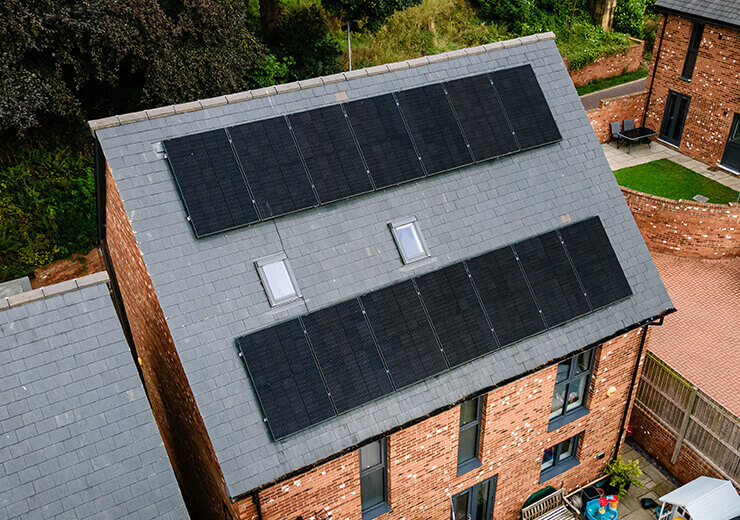
Today, our domestic solar PV systems use modules that would have seemed extraordinarily powerful in the 1950s. A single modern rooftop module can have a rated output measured in hundreds of watts, while an entire home array can produce several kilowatts.
How Much Has Solar Grown Since the Bell Labs Breakthrough?
The scale is difficult to overstate. The International Energy Agency Photovoltaic Power Systems Programme estimated that global cumulative PV capacity approached 3 terawatts by the end of 2025, up from about 2.3 TW in 2024. Around 698 GW of new PV capacity was installed during 2025 alone.
The same IEA PVPS snapshot reported that photovoltaic generation supplied more than 10% of global electricity demand and around 12% of electricity consumption during 2025. Nearly 40 countries installed at least 1 GW of new PV capacity in that single year.
From Experimental Device to Global Electricity Technology
Efficiency bars illustrate selected historical and research milestones, not like-for-like commercial modules. Different cell technologies and test conditions are involved.
Who Invented the Solar Panel Rather Than the Solar Cell?
There is no equally clean answer because a panel is a packaging and interconnection system built around solar cells. Once cells were practical, engineers had to connect them electrically, protect them from moisture and mechanical damage, create stable glass and encapsulant systems, add junction boxes and bypass diodes, and design mounting systems that could survive decades outdoors.
That means the modern PV module is better understood as an engineered evolution rather than a single patented object invented by one person.
What Has Changed Inside a Solar Panel Since 1954?
| Design area | Early photovoltaic devices | Modern rooftop modules |
|---|---|---|
| Semiconductor | Selenium and early silicon junctions. | High-purity crystalline silicon with advanced passivation and contact structures. |
| Efficiency | Sub-1% for early selenium; about 6% for the 1954 Bell Labs cell. | Commercial module efficiencies commonly exceed 20%, with leading products significantly higher. |
| Protection | Experimental laboratory packaging. | Tempered glass, encapsulant, sealed junction box, weather-resistant backsheets or rear glass and robust frames. |
| Electrical integration | Small experimental loads. | String design, MPPT tracking, inverters, grid protection, smart meters, batteries and energy-management software. |
| Expected use | Scientific demonstration and specialist remote power. | Homes, businesses, schools, community buildings, utility farms, transport infrastructure and off-grid applications. |
Why Modern Solar Is More Than Panel Efficiency
One of the lessons from solar history is that no single efficiency breakthrough created today's market. Manufacturing scale, reliability, power electronics, finance, standards, installation practice and grid integration were all necessary.
That is still how we approach a project. A high-efficiency module can be useful where roof area is limited, but it does not rescue poor string design, heavy shading, an unsuitable inverter or weak mounting. We design the complete array and electrical system together, whether it is a home installation or a larger commercial solar PV project.
What Comes After Today's Silicon Solar Panels?
Research now includes tandem cells, perovskite-silicon combinations, multi-junction devices, advanced back-contact cells and new approaches to reducing optical and electrical losses. NREL continues to maintain its Best Research-Cell Efficiency Chart to track independently confirmed records across photovoltaic technologies.
Research-cell records should not be confused with mass-market module efficiency. Laboratory devices can use very different materials, sizes, concentration levels and manufacturing processes. The commercial challenge is to convert scientific records into products that are safe, durable, scalable and affordable for decades of outdoor operation.
Why This History Still Matters When We Design Solar Today
The story of photovoltaics is useful because it shows what “proven technology” really means. Solar did not appear overnight. It has more than 185 years of scientific history behind the photovoltaic effect, more than 70 years since the first practical silicon cell and decades of field deployment in some of the harshest environments imaginable.
When we specify a modern system, we are not simply selecting the latest headline wattage. We look at module construction, verified ratings, roof layout, voltage and current compatibility, inverter behaviour, warranty support, monitoring and how the system will be serviced over its life.
Want to See What Modern Solar Can Do on Your Property?
From a 6% laboratory breakthrough in 1954 to today's high-output rooftop systems, the technology has changed dramatically. The next step is applying it correctly to the building in front of us.
Request a tailored solar PV quote and we can assess roof space, energy use and the system design that makes sense for your property.