
Which Solar Panels Are Best?
Author: Steve Fairless
Originally Published: 21st December 2023 · Updated: 28th August 2026
The best solar panel is not simply the module with the highest wattage or efficiency. For a UK roof, we look for a combination of high power density, proven reliability, appropriate dimensions and weight, low degradation, sensible temperature behaviour, strong product and performance warranties, electrical compatibility with the inverter, and a manufacturer with credible long-term support.
At Sustainable Energy Engineering, we specify panels as part of a complete system. A 500 W module can be a worse choice than a 455 W module if its size prevents a better roof layout, its current exceeds an inverter input limit or its format creates awkward shading. Equally, a higher-efficiency module can be extremely valuable where roof area is the limiting resource.
This August 2026 update compares current technical data from AIKO, LONGi, Trina Solar, JinkoSolar and JA Solar, and combines those datasheets with independent 2026 Kiwa PVEL reliability-testing data. We are not ranking brands from first to fifth; we are showing the engineering factors that matter when selecting a module.
Updated: 28th August 2026. Product specifications below are representative current examples checked against manufacturer documents and can change by region, model revision and availability.
Which Solar Panels Are Best? The Short Answer
- Best for maximum power density: high-efficiency back-contact and advanced n-type modules can exceed 24% module efficiency in current product ranges.
- Best for most roofs: the module that creates the strongest whole-roof layout at the right voltage/current is often better than the one with the biggest nameplate wattage.
- Best for long-term value: prioritise verified reliability, degradation warranty, mechanical design, support and installer accountability as well as efficiency.
- Best for shaded or complex roofs: module choice matters, but system-level MPPT/optimiser/microinverter design can matter more than a small efficiency difference.
- Best overall: there is no universal winner. We shortlist modules for the property, inverter and expected operating conditions.
What “Best Solar Panel” Actually Means in 2026
Modern modules are close enough in headline performance that the wrong comparison can be misleading. A 560 W panel may be physically larger than a 500 W panel. A 25% efficient panel may not generate 25% more energy than a 23.5% panel because the percentage describes conversion efficiency at standard test conditions, not annual site yield.
| Criterion | Why it matters | What we check |
|---|---|---|
| Module efficiency | Determines power per unit of panel area. | STC efficiency, physical dimensions and actual watts per square metre. |
| Power class | Influences panel count and array size. | Whether the wattage improves the roof layout rather than just increasing module size. |
| Temperature coefficient | PV power falls as cells get hotter. | Pmax coefficient and the likely operating environment. |
| Degradation warranty | Indicates the manufacturer's guaranteed long-term output profile. | First-year loss, annual decline and end-of-term guaranteed power. |
| Mechanical design | Roof loads, handling and weather exposure matter. | Weight, dimensions, glass construction and certified static load. |
| Electrical compatibility | Modern high-current modules can stress older inverter assumptions. | Voc, Vmp, Isc, Imp, string length and inverter MPPT/input-current limits. |
| Independent reliability evidence | A datasheet is a specification, not an independent stress test. | Third-party extended testing, field history and manufacturer quality controls. |
Current 2026 Module Examples: What the Datasheets Actually Say
The table below uses current manufacturer documentation available at the time of this update. It is not a price comparison and it does not mean every model is suitable or available for every UK project.
| Manufacturer / model family | Representative high-power variant | Module efficiency | Dimensions | Temperature coefficient of Pmax |
|---|---|---|---|---|
| AIKO Neostar 3P54 | 500 W | 25.0% | 1762 × 1134 × 30 mm | -0.26%/°C |
| LONGi Hi-MO X10 LR7-60HVH | 560 W | 24.8% | 1990 × 1134 × 30 mm | -0.26%/°C |
| Trina Vertex S+ NEG18R.20 | 520 W | 23.4% | 1961 × 1134 × 30 mm | -0.29%/°C |
| JinkoSolar n-type 48HL4M-BDV family | 470 W | 23.52% | 1762 × 1134 × 30 mm | -0.29%/°C |
| JA Solar JAM54D41/LB | 455 W | 22.8% | 1762 × 1134 × 30 mm | -0.29%/°C |
Do Not Read This Table as a Ranking
These products use different physical formats and cell technologies. A larger 560 W module can occupy more roof area than a 500 W residential-format module. Model revisions also change. The right comparison is the complete array that fits the roof, not the biggest watt number on one sheet.
Efficiency vs Wattage: The Difference That Changes Roof Layouts
Efficiency describes how much of the sunlight falling on the module area is converted into electrical power under standard test conditions. Wattage is the total rated output of the whole panel. A physically larger panel can have higher wattage without being more efficient.
Using the published dimensions above, the power density follows the stated efficiencies closely. That matters on a roof with a fixed usable area.
Approximate rated watts per square metre from representative modules
Calculated from representative manufacturer rated power and published module dimensions. Rounded values are for layout comparison only.
Independent Reliability Data Shows Why Brand Reputation Is Not Enough
Kiwa PVEL's 2026 PV Module Reliability Scorecard is valuable because it subjects specific module bills of materials to extended stress testing beyond a simple nameplate specification. The 2026 Scorecard lists 43 manufacturers as Top Performers across one or more test categories and includes 246 unique model types as Top Performers.
However, the same programme reported that 87% of participating manufacturers experienced at least one Product Qualification Program failure, and 45% had at least one delamination failure. Only five bills of materials were listed as Top Performers across all of the Scorecard's reliability tests, and none of those five also topped every reliability test plus PAN performance.
What Those PVEL Numbers Do — and Do Not — Mean
They do not mean 87% of installed solar panels fail in the field. They mean that, within Kiwa PVEL's demanding qualification programme, most participating manufacturers had at least one tested bill of materials experience a failure in at least one PQP test. The lesson for buyers is that manufacturer name alone is not enough; exact model, bill of materials, quality control and independent testing matter.
AIKO: When Maximum Roof Power Density Matters
AIKO's current Neostar 3P54 datasheet lists output up to 500 W from a 1762 × 1134 mm residential-format module, with up to 25.0% module efficiency. The published temperature coefficient of Pmax is -0.26%/°C, and the datasheet states first-year degradation of no more than 1% followed by no more than 0.35% per year from years 2 to 30.
That combination is attractive where the roof has limited usable area and every square metre matters. The engineering question is whether the module's voltage/current characteristics, physical layout and system price create more value than a lower-efficiency alternative.
LONGi: High Efficiency in a Larger Module Format
LONGi's Hi-MO X10 LR7-60HVH datasheet covers 535–560 W modules with efficiencies up to 24.8%. The 560 W unit is 1990 × 1134 × 30 mm and weighs 24.8 kg. LONGi publishes a -0.26%/°C Pmax temperature coefficient and a 30-year power warranty profile.
The key point is format. A 560 W panel sounds substantially “bigger” than a 500 W panel, but some of that gain comes from the physically longer module. On a simple roof that may be excellent. Around dormers, hips, rooflights or tight eaves, a smaller module can sometimes create a better total array.
Trina Solar: Strong Output in a 1961 mm Module
Trina Solar's current Vertex S+ NEG18R.20 datasheet lists 490–520 W variants, reaching 23.4% efficiency at 520 W. The module measures 1961 × 1134 × 30 mm and weighs 23.5 kg. Trina lists a 15-year product warranty and 30-year power guarantee for this family, with a -0.29%/°C Pmax temperature coefficient.
The dual-glass construction and published 5400 Pa front / 2400 Pa rear maximum static mechanical loading are examples of the non-wattage specifications we examine on a real roof.
JinkoSolar: High-Power Residential n-Type Formats
JinkoSolar's current 445–470 W n-type bifacial 48-cell module family reaches 23.52% module efficiency at 470 W in a 1762 × 1134 × 30 mm format. The datasheet lists a 15-year product warranty, 30-year linear power warranty, 1% first-year degradation and 0.40% annual degradation thereafter.
Jinko also publishes higher-power Tiger Neo 3.0 products for other formats, showing how important it is to compare the exact module rather than treating a brand name as one fixed specification.
JA Solar: Proven Mainstream Residential Format
JA Solar's JAM54D41/LB family reaches 455 W and 22.8% module efficiency in a 1762 × 1134 × 30 mm dual-glass format weighing about 22 kg. The datasheet lists a Pmax temperature coefficient of -0.29%/°C.
On a roof where the lower wattage still allows the required number of modules to fit, a panel like this can remain a sensible engineering choice. The “best” module is the one that creates the best system outcome at the required quality and price.
Why Temperature Coefficient Matters
Solar modules are rated at a cell temperature of 25°C under standard test conditions, but cells can become much hotter on a sunny roof. A Pmax coefficient of -0.26%/°C means rated power falls by about 0.26% for every degree the cell temperature rises above the reference condition, all else equal.
The difference between -0.26%/°C and -0.29%/°C is not usually enough to decide a system on its own, but it contributes to annual yield and is part of a proper comparison.
Why Electrical Current Is Becoming More Important
As module power has risen, module current has increased in many product families. Inverters have maximum input-current and short-circuit-current limits per MPPT. If a panel's current exceeds what the inverter can accept, the system may clip, derate or simply be incompatible with the intended string design.
This is why we never choose panels independently from the inverter. Our home solar designs start with the roof and electrical architecture together.
What About Shading?
Panel technology can influence low-light behaviour, but the larger determinant on a shaded roof is often system architecture. Good string placement, separate MPPTs, optimisers where justified, or microinverters in certain designs can reduce the effect of mismatch.
No module makes heavy shade disappear. A high-efficiency panel under a chimney shadow can still produce less energy than a lower-efficiency panel in full light.
What About Coastal or Exposed Roofs?
For coastal and exposed North East locations, we review corrosion-related certification, module frame and glass construction, mounting-system compatibility and site wind loading. IEC 61701 salt-mist testing is one relevant certification for modules used in salt-laden environments, but site-specific structural design remains essential.
The best module cannot compensate for poor roof fixings or an inadequately designed mounting system.
Residential vs Commercial: The Best Panel Can Be Different
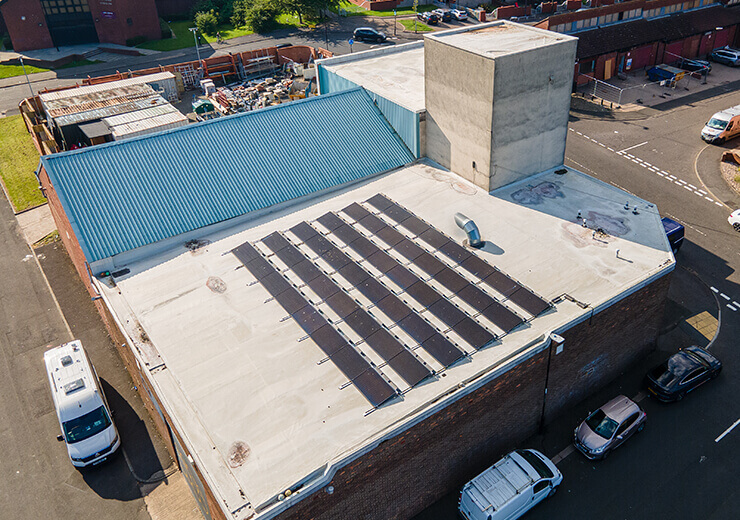
Homes often have complex roof geometry and a premium on watts per square metre. Commercial roofs may have much larger areas where handling, structural load, cable design, string length, maintenance corridors and total installed cost per kWp become more important.
That is why a module that is ideal for one of our home installations may not be the same product we select for a commercial solar PV system.
How We Compare Warranties
A long warranty headline is useful, but we read the detail. Product warranty, performance warranty and installer workmanship cover different risks. We also consider whether the manufacturer has a credible process for claims and whether the exact module serials and commissioning documents are recorded.
Our Solar Panel Selection Checklist
- Confirm exact model and datasheet revision.
- Calculate the best roof layout with real dimensions.
- Compare watts per square metre, not just watts per panel.
- Check module weight and roof-loading implications.
- Check Voc and cold-temperature string voltage.
- Check Imp/Isc against inverter MPPT and short-circuit-current limits.
- Review Pmax temperature coefficient.
- Review product and linear performance warranties.
- Check glass, frame, junction box and mechanical-load data.
- Look for independent reliability testing where available.
- Check manufacturer support, UK availability and replacement practicality.
- Model the complete system's annual generation and financial value.
Should You Always Buy the Highest-Efficiency Panel?
No. High efficiency is most valuable when roof space is scarce. If a roof can already accommodate enough lower-cost modules to meet the design objective, paying more for the highest possible efficiency may not produce the best financial return.
Conversely, on a small roof, moving from roughly 22.8% to 25% module efficiency can create meaningful extra system capacity in the same area. The value is therefore property-specific.
How We Choose Panels for Our Own Installations
We do not select modules by a single league table. We shortlist products that fit the roof, match the inverter, have credible technical documentation and warranty support, and perform well enough to justify their place in the system. Then we compare the total installed array rather than one module in isolation.
For some roofs, the best answer is maximum efficiency. For others it is a slightly lower-power panel that fits around roof features more effectively. For a large business roof, the priority may be reliable high-volume modules that produce the required kWp with efficient installation and maintenance access.
The panel is important, but it is only one part of a solar investment that includes design, mounting, inverter engineering, protection, monitoring, documentation and long-term support.
Want a Panel Recommendation Based on Your Roof?
We can compare module format, usable roof area, projected output and the rest of the electrical design before recommending a system. That is much more useful than choosing from a generic “top five” list.
Request a tailored solar quote and we will design around the property rather than forcing the property around a panel.