
How Solar System Design Impacts ROI More Than Panel Efficiency Alone
Author: Steve Fairless
Originally Published: 1st June 2026 · Updated: 2nd September 2026
High panel efficiency is useful, especially where roof area is limited, but it does not make a complete solar system efficient by itself. Annual generation and financial return depend on how much suitable roof area is used, orientation and shading, string and inverter design, electrical limits, downtime, self-consumption, export and—where fitted—battery behaviour.
At Sustainable Energy Engineering, we select modules as part of a system. We would rather use the roof intelligently with compatible equipment than choose the highest headline module efficiency and then compromise the array layout or electrical design.
Panel Efficiency vs System Design: The Short Answer
- Module efficiency tells you how much power a panel can produce from a given area under standard test conditions.
- It matters most when roof area is constrained. Higher efficiency can fit more installed kWp into the same usable surface.
- Annual kWh depends on more than efficiency. Location, orientation, inclination and shading directly affect yield.
- Inverter and string design can create bottlenecks. Voltage, current, MPPT grouping and clipping all matter.
- ROI depends on usable energy, not just generated energy. A well-designed system matches production with on-site demand, storage and export.
What Panel Efficiency Actually Measures
Module efficiency is the percentage of incident solar energy converted into electrical output under defined test conditions. A higher-efficiency module can therefore deliver more watts from the same physical area. This is valuable on a small roof where every square metre is scarce.
What it does not tell you is how many kWh that module will produce on a particular roof over a year. It does not include local solar resource, roof pitch, azimuth, shade, inverter operation, wiring losses, availability or curtailment.
The MCS Performance Method Shows Why Site Design Matters
MCS 032:2025 starts with installed array capacity in kWp and then applies location, inclination, orientation and shading information to estimate annual output. That structure is important because it separates the module’s nameplate power from the site conditions that determine usable annual energy.
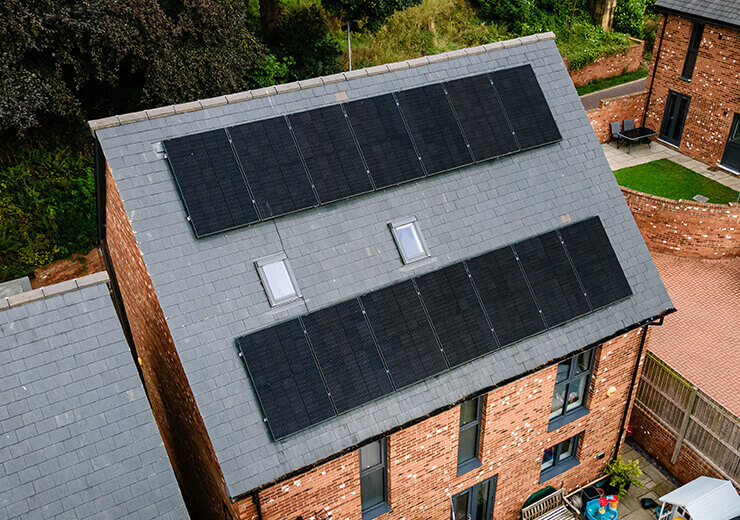
When we design solar PV for a home, we use the available roof geometry to decide how much capacity can be installed and then model how that capacity will perform. A nominally less-efficient module can still be part of the stronger system if its dimensions, current, voltage or layout allow us to use the roof better.
A Higher-Efficiency Panel Can Still Be the Wrong Size
Residential modules are not all the same dimensions. Suppose one high-efficiency product leaves awkward unused strips around dormers or roof edges while another slightly lower-efficiency format allows an extra row or a cleaner string. The second layout can produce more total kWh even though the individual module specification looks less impressive.
We Compare Watts per Usable Roof, Not Just Watts per Panel
A 500 W module is not automatically better than a 450 W module. It may simply be larger. The useful comparison is installed power and modeled yield within the actual safe, serviceable roof area.
Shading Can Outweigh a Small Efficiency Difference
A few percentage points of module efficiency can be less important than persistent shade from a chimney, tree, dormer or neighbouring building. Good design may mean leaving a marginal location empty, splitting orientations across separate MPPTs or using module-level electronics only where they solve a real mismatch problem.
PVGIS and MCS-style performance estimation help move the discussion from “best panel” to “expected annual yield from this roof”.
String and MPPT Design Can Limit a Premium Array
Modules operate within voltage and current ranges set by the inverter. Strings must remain within maximum voltage at low temperature and within useful MPPT ranges under operating conditions. Modern high-current modules also need to suit the inverter input-current limits.
If different orientations or shade profiles are grouped poorly, the array may not operate at its best point. Panel efficiency does not fix an invalid or compromised electrical design.
Inverter Sizing Is a System Decision
The DC array size and AC inverter rating do not have to be identical. A considered design can use DC oversizing where manufacturer limits, expected simultaneous output and network requirements support it. The correct relationship depends on roof orientation, clipping risk, location, battery integration and future expansion.
Self-Consumption Can Matter More to ROI Than Another 0.5% of Module Efficiency
A household saves most directly when solar generation replaces electricity it would otherwise import. If an extra 100 kWh is generated at times when it is all exported, its financial value can be different from 100 kWh consumed on site.
That is why the design conversation includes load timing and energy-tariff strategy, not just panel conversion efficiency. The strongest return can come from matching the generation curve to the building’s actual demand.
Battery Storage Adds Another Design Layer
Storage can shift midday surplus into the evening, but the battery has usable-capacity and power limits and introduces conversion losses. The PV array, inverter and battery storage should therefore be sized together if storage is part of the plan.
| Design factor | Potential effect | What we check |
|---|---|---|
| Usable roof area | Changes the total kWp that can be installed | Module dimensions, edge zones, obstructions and maintenance access. |
| Orientation and pitch | Changes annual and time-of-day yield | Location-specific modelling rather than a generic “south is best” rule. |
| Shade | Can reduce output and create mismatch | Seasonal obstruction geometry and electrical grouping. |
| Inverter/MPPT design | Can constrain voltage, current or peak conversion | Datasheet limits and predicted simultaneous power. |
| Self-consumption | Changes the financial value of generated kWh | Load profile, export and storage strategy. |
What Current Module Efficiency Tells Us About Buying Decisions
Commercial silicon module efficiency has continued to improve, and current premium products occupy a relatively narrow high-efficiency band. That makes it increasingly unhelpful to choose a system on efficiency alone. Once several credible products all make good use of the roof, differences in dimensions, degradation warranty, mechanical design, electrical characteristics, reliability evidence and support can be more useful differentiators.
Our Design Sequence
How We Decide What Belongs on the Roof
- Measure the usable roof area and identify obstructions, structure and safe mounting zones.
- Model orientation, inclination and shading.
- Choose module dimensions and electrical characteristics that fit the roof.
- Design strings and MPPT groups within voltage/current limits.
- Select the inverter and network-connection approach.
- Model annual generation and self-consumption.
- Add battery/EV/heat-pump requirements where relevant.
- Compare whole-system energy and financial performance, not just panel labels.
Our Recommendation: Optimise the System Before the Specification Sheet
Panel efficiency deserves attention, particularly on small or complex roofs. But it should answer a design problem rather than become the design itself. The objective is the best safe, serviceable and financially useful system for the property.
A Simple Layout Example Shows Why Dimensions Matter
Imagine a roof that can safely accommodate either ten smaller high-efficiency modules or eight physically larger modules. The larger product might have the higher individual wattage, yet the ten-module arrangement can still provide more total installed kWp. Reverse the roof dimensions and the larger module may win instead.
This is why we place actual module rectangles on the measured usable roof area rather than comparing catalogue wattages in isolation. Roof utilisation is geometry before it is marketing.
Efficiency Also Interacts With Temperature
Module efficiency is quoted under standard test conditions, but rooftop cells often operate hotter than 25°C in strong sun. Datasheets provide temperature coefficients describing how voltage and power change with temperature. Those figures are used in electrical design and help predict real operating behaviour.
Again, the best coefficient does not automatically identify the best system. A module with marginally better hot-weather behaviour can still lose the comparison if fewer modules fit or the electrical grouping is weaker.
Clipping Is Not Automatically Evidence of Bad Inverter Sizing
If DC array capacity exceeds the inverter’s AC rating, there can be short periods when available PV power is higher than the inverter converts. That is called clipping. A small amount of clipping can be a rational trade-off if the larger DC array produces more energy during the many hours when irradiance is below peak.
The design question is how much annual energy is lost versus how much additional shoulder-hour generation is gained—not whether the DC and AC labels match exactly.
Design Should Consider the Next Upgrade as Well as Today
If a customer expects to add a battery, EV, heat pump or extra PV, we consider whether the proposed inverter, consumer-unit work, monitoring and network connection make that future change easier. Choosing every component only for the minimum current requirement can create unnecessary replacement cost later.
Future-Proofing Does Not Mean Oversizing Everything
It means knowing which future changes are genuinely likely and avoiding obvious dead ends. Oversized batteries, unnecessarily large inverters or unused equipment can weaken ROI just as much as a system that cannot be expanded.
The Best Design Has a Traceable Reason for Every Major Choice
- Why this module format rather than another?
- Why this number of modules and this roof layout?
- Why are strings grouped on these MPPTs?
- Why is this inverter power appropriate?
- How was annual generation estimated?
- How much energy is expected to be used on site?
- What has been allowed for future loads or storage?
Want Us to Compare the Whole System Rather Than One Panel Number?
We can model roof utilisation, expected generation, inverter design and storage around your actual consumption.