
Can Solar Panels Be Installed on a Slate Roof?
Author: Steve Fairless
Published: 7th September 2026
Yes, solar panels can be installed on slate roofs, including many natural-slate and fibre-cement roofs, but slate demands careful handling and a mounting method that transfers loads into the roof structure rather than relying on the slates themselves. The roof covering must continue to shed water correctly after brackets and flashings are fitted, and suitable replacement slates should be available before work begins.
At Sustainable Energy Engineering, we do not treat a slate roof as a tiled roof with thinner tiles. Natural slate can be strong in service yet brittle under the wrong point load. Older slates can also vary in thickness and size, while historic or regional slates may be difficult to match.
This guide explains the main mounting options, what happens if a slate breaks, why flashing matters, how to distinguish repairable defects from a roof that needs wider work and what a homeowner should expect from a proper survey.
Solar Panels on Slate: The Short Answer
- Slate roofs can be excellent solar roofs. Suitability depends on condition, structure, slate type and the availability of a compatible mounting system.
- The slates are not the structural anchor. Solar loads should be transferred to suitable structural timber or another engineered support.
- Do not accept brackets that leave slates rocking or lifted. The finished roof covering should remain stable and weather-resistant.
- Have matching replacement slates ready. A few units can break during access or installation even when care is taken.
- Older slate roofs need a broader condition check. Nails, battens, underlay, flashings and timber condition can matter as much as the visible slate surface.
Natural Slate and Fibre-Cement Slate Are Different Roof Coverings
| Roof covering | Typical characteristics | Solar design implication |
|---|---|---|
| Natural slate | Stone product split into thin units; thickness and size can vary, especially on older roofs. | Handle carefully, avoid point loads, match replacement slate and use details appropriate to the existing fixing method. |
| Fibre-cement slate | Manufactured, usually more uniform in size and thickness. | Still brittle; confirm product condition, fixing pattern and compatible bracket/flashing solution. |
| Historic or local slate | May be irregular, scarce or visually distinctive. | Replacement supply should be confirmed before installation and heritage considerations may influence the layout or fixing approach. |
| Reclaimed slate roof | Can contain mixed ages, thicknesses or previous repairs. | Survey the actual roof rather than relying on a generic slate specification. |
How Are Solar Panels Fixed Without Loading the Slates?
A typical slate-roof mounting design locates the structural rafters, removes or carefully lifts selected slates and fixes purpose-designed brackets into the structural roof. The weather layer is then reinstated around the bracket using the mounting manufacturer's slate detail, replacement slates and/or appropriate flashing.
The rail is attached to the bracket and the module is fixed to the rail. This creates a load path from panel to rail, rail to bracket and bracket to structure.
The slate's job remains weather protection. It should not become the accidental spacer or structural bearing surface for a bracket carrying wind uplift and snow loads.
Why Replacement Slates Should Be Ready Before Installation
Historic England's PV guidance advises that some tiles and slates might be broken when panels are installed over an existing roof covering and recommends having suitable replacements available. It also warns that traditional roof coverings, including some stone or handmade products, can be difficult to source.
A Practical Slate-Roof Rule: Match Before You Lift
Before scaffold and installation day, identify the slate type, approximate size, thickness, colour and fixing arrangement. If the material is unusual, source an appropriate batch of replacements first. This reduces the risk of a system being completed over a roof patched with visibly incompatible units.
Source: Historic England, Considerations When Planning a PV Installation, section on impact on building fabric, current guidance accessed August 2026.
Do Slates Have to Be Drilled for Solar Panels?
Not as a default way of carrying the array. The mounting design should use a purpose-made roof detail intended for slate. Depending on the system, that may involve removing a slate, fitting a structural bracket and weathering the position with a replacement slate and flashing.
Unplanned holes through slate create avoidable weathering risks. Any penetration that is part of an approved system needs to be detailed exactly as the manufacturer requires.
What Does MCS Say About Slate and Tiled Roof Brackets?
MCS MIS 3002 Issue 6.0 references the code-of-practice principle that roof brackets on a slate or tiled roof should not impose load on the roof covering. MCS provides an exception where a bracket is specifically designed to transfer an evenly distributed load to the covering without damage and has been demonstrated through MCS 012 certification.
It also states that where slates or tiles would otherwise be displaced and left with greater gaps than before the installation, they should be notched or flashed as appropriate.
A Slate Should Not Be Forced Back Over the Wrong Bracket
If a bracket geometry does not suit the slate build-up, forcing the slate down can crack it immediately or preload it so it fails later. The correct answer is the right bracket, flashing and slate detail—not tightening the array until the roof covering submits.
Source: MCS, MIS 3002 Solar PV Systems, Issue 6.0, sections 5.3.1 and 5.9.8, 18 March 2026.
How Can You Tell Whether an Older Slate Roof Is Ready for Solar?
We look at more than missing slates. An older roof can appear neat from the street while nails are failing, battens are weak, underlay is degraded or previous repairs have introduced uneven loading.
Slate Roof Condition Checklist
- Are there slipped slates or “tingles” from previous patch repairs?
- Do slates sound or feel delaminated, soft or excessively brittle when inspected safely?
- Are nail fixings failing across a wider area?
- Is there daylight, water staining or dampness in the loft?
- Are battens and rafters sound around the proposed fixing zones?
- Have valleys, chimneys or abutments been patched repeatedly?
- Is the roof due for a major overhaul within the likely operating life of the PV system?
- Can replacement slates of an appropriate type be sourced?
What About Welsh Slate, Spanish Slate and Other Natural Products?
The solar design should respond to the roof in front of us rather than make assumptions from the slate's country of origin. Natural slate varies by quarry and product, while older roofs may have been reslated, repaired or mixed over many decades.
What matters to the installation is the condition, thickness, fixing method, overlap, batten arrangement and how the selected mounting system is intended to integrate with that roof.
Can a Slate Roof Be Too Fragile for Solar?
Yes. If the roof covering is failing widely, it may be more sensible to repair or reslate before installing PV. The same applies if the underlying structure is defective. Solar should not be used to cover a maintenance problem that will still need access in a few years.
That does not mean every old slate roof needs replacement. Many traditional slate roofs have long service lives when maintained. A condition-led decision is more useful than an age rule.
How Do Solar Panels Affect Water Flow on a Slate Roof?
An on-roof array sits above the slate and rain still drains over the roof covering underneath. The bracket positions should not create lifted slates, open side laps or routes where water can be driven beneath the covering.
Cables also need deliberate routing. A cable draped across a valley, gutter or roof surface can trap debris and complicate maintenance. We want cabling clipped and protected without creating new roof penetrations unnecessarily.
Does Solar Make Slate Roof Repairs More Difficult?
Access beneath an array is more involved than access to an exposed roof. Individual peripheral slates can often still be repaired, but work directly beneath panels may require module removal. That is why known defects should be dealt with before installation.
A clean design also leaves sensible margins around chimneys, rooflights, valleys and abutments so common maintenance tasks do not require dismantling half the array.
Solar on a Slate Roof in a Conservation Area or Listed Building
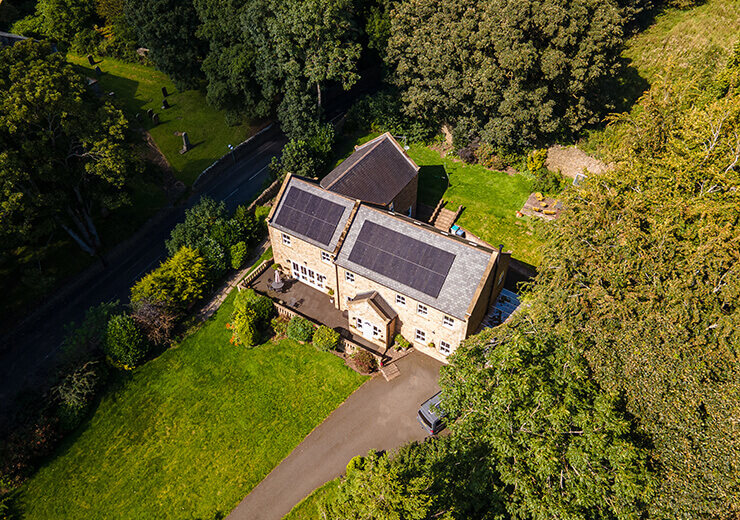
Natural slate is often part of the character of historic buildings and conservation areas. Planning or listed-building controls can therefore be as important as the engineering. A prominent array over an important historic slate roof may be more sensitive than the same panel system on a later rear extension.
Where heritage controls apply, the design should consider visibility, array proportion, reversibility and physical intervention in the original covering before the layout is fixed.
What About Fire, Structure and Weather-Tightness?
These are part of one roof-system decision. The mounting must withstand calculated actions, the structure must have capacity for the array, the weather covering must remain effective and the installed system must maintain appropriate fire performance.
For a homeowner, that is why “how many panels fit?” comes after “is the roof suitable?” Our domestic solar PV design process starts with the usable building surface and energy profile before the final equipment schedule.
Our Preferred Outcome on a Slate Roof
The Roof Should Still Look Like a Slate Roof
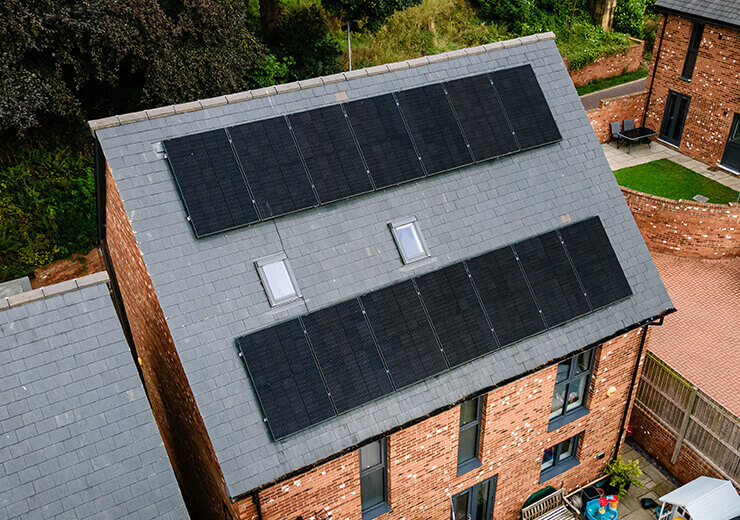
After installation, the slates around mounting points should sit naturally, replacement units should be visually compatible, flashings should be tidy, rails should be aligned and no unnecessary roof penetrations should be visible. From inside the loft there should be no new signs of water ingress or structural distress.
Why Slate Fixing Condition Matters as Much as Slate Condition
A slate can look perfectly serviceable while the nails or other fixings holding it are deteriorating. If many slates are slipping or have already been secured with repair clips, the issue may be broader than a few broken units.
Solar installation involves temporary access and local disturbance of the covering. Where the roof is already at the point that ordinary maintenance causes repeated slippage, it is sensible to investigate the fixing system before placing an array over it.
How Matching Replacement Slate Protects the Finished Roof
Matching is not just about colour from the pavement. Size, thickness and lap affect how the roof sheds water. A replacement that is too thick can lift neighbouring units; one that is too thin may sit poorly or need inappropriate packing.
On an older natural-slate roof, visual variation is normal, so the goal is compatible rather than artificially identical material. A roofing professional can help identify whether salvaged or new slate is appropriate for repairs around the solar brackets.
Should Solar Rails Follow the Slate Courses?
The array should look aligned with the roof, but the structural fixings have to follow the actual rafter and mounting requirements. Rail positions are therefore the result of two systems: the visible module grid and the hidden structural grid below.
A good design resolves both without forcing fixings into weak locations or creating an array that looks noticeably twisted against the roof lines.
Access Is Especially Important on Brittle Roof Coverings
Slate roofs reward careful access planning. Scaffold position, roof ladders, material handling and where installers place their weight can influence breakage risk before the first bracket is fitted.
NFRC safety guidance notes that a typical solar collector can weigh around 20 kg and emphasises planned lifting, safe access and avoiding overloading roof surfaces with materials. The figure is a handling reference rather than a module-weight rule—modern modules vary by size and construction.
Why Handling Is Part of Roof Protection
Panel damage is not the only concern during lifting. A large module carried across a fragile slate roof can force operatives into poor foot positions or create impact risk. Proper scaffold, hoisting and team handling protect both people and the roof covering.
Source: National Federation of Roofing Contractors, HSGS13 Safe Handling of Solar Collectors on Roofs, revised May 2021 and current in the NFRC resource library.
Natural Slate on Heritage Buildings Needs Extra Coordination
If the property is listed or the roof contributes strongly to a conservation area, replacing original slate, changing roof lines or introducing visible metalwork can become a heritage issue as well as a roofing issue. The solar layout should then be developed alongside the consent strategy.
Even where formal consent is not required, a low-profile, rectangular array with controlled cabling generally creates a better architectural result than irregular panel groups squeezed around every obstruction.
What Documentation Should a Slate-Roof Owner Keep?
Keep a Record of the Hidden Details
- photos of the slate condition before installation;
- the make/model of the slate roof mounting system;
- bracket and rafter positions;
- replacement slate and flashing details;
- photos before modules conceal the completed roof work;
- electrical and commissioning documentation;
- any roofer's report or structural advice obtained before installation.
Those records make future maintenance easier because a roofer or solar engineer can understand how the array interfaces with the covering without dismantling it simply to discover the original detail.
What About Roof-Integrated Solar on a Slate Roof?
If a slate roof is already being renewed, an integrated PV system can be considered as an alternative to rails above the covering. In that arrangement, the PV tray or module system replaces part of the slates and becomes part of the weatherproof roof build-up.
This can reduce the visual projection of the array, but it is not automatically “gentler” on an existing slate roof because it requires a larger area of covering to be removed. On a sound existing natural-slate roof, an on-roof mounting system may involve less disturbance overall. On a planned reslate, integrated PV can make more sense because the roof is already being opened.
The decision should compare appearance, weathering, ventilation, fire classification, future replacement parts and how easily individual roof components can be maintained later.
How Many Spare Slates Should You Have?
There is no universal number because the answer depends on roof size, slate condition, access difficulty and how easy the product is to replace. The important principle is to avoid starting work on a scarce or historic covering with no replacement material available at all.
For an ordinary modern slate product, replacements may be straightforward to source. For an older natural slate, the homeowner or roofer may need to identify a compatible reclaimed or new material in advance. Keeping a small matching stock after the installation can also make future maintenance easier.
Will Solar Change the Appearance of a Slate Roof More Than a Tiled Roof?
Dark modules can sit visually well against many slate roofs, particularly when the array is rectangular and rails and cables are controlled. The bigger aesthetic issues are usually geometry and roof proportion rather than colour alone.
On an architecturally sensitive property, we would avoid scattered panel groups where possible and consider how the array lines relate to ridges, eaves, chimneys and rooflights. A clean arrangement often looks more deliberate and makes future maintenance simpler too.
Slate and Solar Can Work Very Well Together
Slate is not a reason to reject solar. It is a reason to select the right mounting detail and installer. A sound slate roof with well-planned structural brackets can carry a high-quality PV system without asking the slates themselves to do a job they were never designed to do.
The most valuable part of the process is often the survey: identify the slate, understand the roof, secure replacement materials and decide whether any repairs are best completed before the array goes on.
How We Use the MCS 400 mm Rule on a Slate Roof
MCS MIS 3002 says solar modules should not normally be mounted within 400 mm of a domestic roof edge unless specific measures deal with the higher wind-uplift forces, secure ridge tiles, rainwater run-off and snow risk. On a slate roof, that is not just a line we draw to make the array look tidy.
We use the edge zone together with rafter positions, slate condition, valleys, abutments and maintenance access to decide the real usable panel area. If achieving a target panel count would force brackets into poor structural positions or leave fragile slates crowded around an edge detail, we would rather change the layout than make the roof carry an avoidable risk.
Source applied to our design: MCS MIS 3002 Issue 6.0, section 5.9.7. The standard also requires tiles or slates to be notched or flashed where necessary so the installation does not create gaps greater than those that existed before the work.
Thinking About Solar on a Slate Roof?
We can assess the roof arrangement, likely mounting approach, usable solar area and your electricity consumption as one design exercise.
Request a tailored solar quote with details of the roof and your annual electricity use.