
Solar for Warehouses: Designing Commercial PV Around the Building and the Load
Author: Steve Fairless
Published: 24th May 2026 · Updated: 2nd September 2026
Warehouses can be exceptionally good buildings for commercial solar, but the opportunity comes from the combination of usable roof area, daytime electricity demand, structural suitability and a workable grid connection — not from roof size alone. A large warehouse can support a substantial array, yet a poor design can still create avoidable export, difficult maintenance, roof-warranty problems or a generation connection that limits the business later.
At Sustainable Energy Engineering, we start a warehouse project with the building and load profile. We want to know what the site consumes every half hour, which roof zones can genuinely carry PV, how the business is likely to electrify, what the DNO will accept and how the system will be accessed and maintained throughout its operating life.
This approach matters particularly on industrial estates, where sheeted roofs, fragile rooflights, multiple tenants, three-phase supplies, EV fleets, refrigeration, automation and future expansion can all affect the correct system size.
Updated: 2nd September 2026.
Are Warehouses Good for Solar Panels?
- Often, very good. Large roofs and significant daytime loads can create strong self-consumption.
- Gross roof area is not usable solar area. Rooflights, smoke vents, drainage, plant, fire routes, shading, structural zones and maintenance access reduce the practical array.
- Roof condition and fragility come first. Older sheeted roofs require competent assessment before anyone plans PV work above them.
- The DNO route can shape the project. Large systems are commonly G99 connections and may require an agreed export limit.
- Future loads should be included now. EV charging, automation, electric heating or added refrigeration can change the optimum PV and battery design.
The Commercial Opportunity Is the Roof and the Load Working Together
A warehouse with a large roof but very little daytime electricity demand may export most of its generation. A smaller warehouse with continuous daytime operations can use a much higher proportion on site. We therefore do not rank opportunities by square metres alone.
For businesses considering solar PV for business, we compare predicted generation with half-hourly electricity use. That shows how much PV can replace imported energy at the point it is generated and how much is likely to be exported.
What Half-Hourly Data Tells Us
| Pattern | What it may mean for the design |
|---|---|
| Stable weekday daytime load | Often supports high direct self-consumption and a larger array. |
| High night load | May strengthen the case for storage or a different tariff strategy. |
| Weekend shutdown | Increases export during two days of each week unless other loads remain. |
| Seasonal production | Requires month-by-month modelling rather than a single annual load figure. |
| Planned EV fleet | Can create a new controllable demand that should be coordinated with PV and supply capacity. |
Usable Roof Area Is Usually Smaller Than the Aerial Photograph Suggests
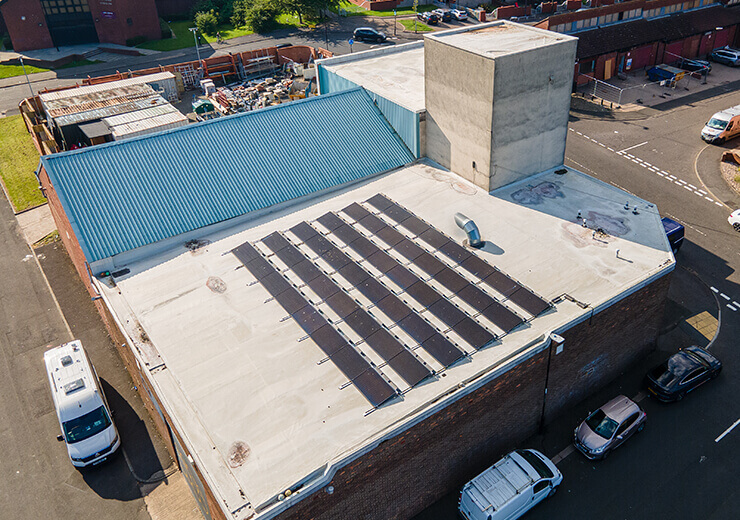
Industrial roofs often contain rooflights, vents, smoke-control equipment, drainage runs, access hatches, plant, gutters and structural bays that constrain a solar layout. We also need clear routes for inspection and future roofing work.
On pitched or curved sheeted roofs, the mounting system must suit the actual roof build-up and structural support. On flat roofs, ballast, wind loading and membrane protection can become decisive. A layout that looks efficient on a drawing is not useful if it blocks drainage or makes routine roof maintenance unsafe.
Fragile Roofs and Rooflights Are a Primary Design Constraint
HSE states that all roofs should be treated as fragile until a competent person confirms otherwise. Its current fragile-surface guidance says falls through fragile surfaces, particularly fibre-cement roofs and rooflights, account for 22% of fatal fall-from-height injuries in construction. That is directly relevant to warehouse PV because industrial roofs frequently include rooflights and older sheeted materials.
We build access and working-at-height controls into the programme from the start. The solution can involve edge protection, stagings, walkways, fall-restraint or fall-arrest systems, safety nets and controlled roof routes, depending on the roof and the method of work.
Never Treat a Rooflight as a Walking Surface
Old rooflights can be difficult to distinguish from surrounding sheets and may become more fragile with age. A solar layout must preserve safe access around them rather than turning the completed array into an obstacle course for future maintenance.
Structural Assessment Includes Wind and Roof Condition
The panel and mounting weight is only one load case. The completed array changes wind actions on the roof and structure, and the mounting system transfers those forces into purlins, rafters or deck. Ballasted systems can add substantially more permanent load.
Approved Document A is part of the structural framework in England. On real commercial projects, we also need the existing structural information, roof manufacturer's details where available and the mounting-system design data. If records are incomplete, investigation may be necessary before we commit to the final layout.
Roof Warranty, Lease and Landlord Consent Need to Be Resolved Early
A warehouse may be owner-occupied, leased or part of a wider investment estate. We want to know who owns the roof, who is responsible for maintenance, whether the covering is under warranty and what consent is required for fixings, cable routes or electrical alterations.
A strong PV business case can be undermined if the roof is due for replacement halfway through the project life or the lease does not give the operator enough certainty to realise the expected savings. We would rather surface that issue before detailed design than discover it after procurement.
Three-Phase Electrical Design Is More Than Choosing a Large Inverter
Warehouse loads are commonly distributed across three phases and can include motors, refrigeration, conveyors, compressors, HVAC, process equipment and chargers. We review the main switchgear, supply capacity, transformer arrangements, metering and existing generation before finalising the PV connection.
For larger systems, our three-phase battery retrofit work also informs how we think about storage and future flexibility. Battery power, inverter capacity and phase arrangement have to match the actual site rather than simply the array kWp.
G99 Is Common on Warehouse Solar
The current GB distributed-generation connection guide uses G98 for compliant microgeneration with combined registered capacity no higher than 16 A per phase. Most meaningful warehouse projects exceed that threshold and therefore use the G99 connection process.
We establish the DNO route early because the network response can affect inverter capacity, export, protection and programme. A project can be technically attractive on the roof and still need changes at the grid interface.
Export Limitation Under G100 Can Unlock a Better Behind-the-Meter Design
Where the network cannot accept unrestricted export, an export-limitation scheme designed to the relevant G100 requirements can sometimes allow a larger behind-the-meter generation system while keeping export within an agreed ceiling.
The commercial value depends on the site's load. If the warehouse consumes 250 kW through much of the working day, a 100 kW export limit may rarely constrain a larger PV array. If operations stop at weekends, the same system may reach the export limit frequently. That is why we model time, not just annual kWh.
Array Size, Inverter Capacity and Export Limit Are Different Numbers
We keep the DC array kWp, AC registered capacity and agreed export limit separate in the design. Conflating them can lead to a system that is unnecessarily small or incorrectly connected.
Battery Storage: Useful Where It Solves a Specific Commercial Problem
A warehouse battery can capture solar that would otherwise be exported, shift cheaper grid electricity, reduce peaks or support selected resilience objectives. It can also be paired with high-power EV charging or other flexible loads. But storage is not automatically the best use of capital on every high-self-consumption warehouse.
We model the battery around throughput and power. If the site has enough daytime load to consume nearly all PV, there may be little surplus to store. If the warehouse has short demand peaks, kW capability may matter more than adding a very large kWh capacity.
EV Fleet Charging Can Turn Solar Into Transport Energy
Fleet electrification can materially change the value of warehouse PV. Vehicles that return to depot during the day can absorb solar directly, while overnight charging can use lower-cost tariff windows. The important part is coordination: PV, battery, charger load management and the site's supply capacity should be designed as one system.
We also allow for future charger numbers and vehicle duty cycles rather than sizing the electrical strategy around today's first two vans.
How We Model Commercial ROI
We separate every kWh into the value it is expected to create. Electricity used directly on site can avoid an import at the applicable commercial rate. Export earns the contracted export value. Stored energy has conversion losses and battery costs. Demand-management benefits depend on the specific tariff and metering arrangement.
We do not claim that warehouse solar always has a faster payback than domestic solar or that one percentage applies to every business. The quality of the return depends on load alignment, capital cost, financing, export, maintenance, roof life and the future price of electricity.
Monitoring Needs to Match the Scale of the Asset
A large commercial array can lose meaningful value if one inverter or string underperforms for weeks. We want monitoring to show inverter availability, generation, alarms and site energy flow at a level that makes faults visible.
For multi-building estates, monitoring design should also make it easy to compare sites and normalise performance. A dashboard that only displays a large cumulative kWh number is not enough to manage an energy asset.
What We Want Before We Design a Warehouse Array
Commercial Solar Information Checklist
- 12 months of bills and half-hourly electricity data.
- Site plan and roof drawings, if available.
- Roof material, age, warranty and condition information.
- Structural drawings and purlin/deck information.
- Asbestos register and fragile-roof information where relevant.
- Main incoming supply, switchgear and transformer details.
- Existing generation, batteries or export controls.
- Lease, landlord and roof-access constraints.
- Planned EV charging, process expansion or electrification.
- Operational hours, shutdown periods and weekend demand.
Our View: Use the Whole Roof Only When the Whole Project Supports It
Warehouses can deliver excellent commercial solar projects because they often combine roof area with predictable demand. The strongest result is not automatically the maximum number of modules. It is the largest sensible system the roof, structure, electrical infrastructure, network connection and business load can support economically.
Our commercial solar service is built around that integrated assessment rather than a price-per-panel approach.
Planning Solar for a Warehouse or Industrial Unit?
Send us your half-hourly electricity data, site address, roof information and details of any planned EV or battery project. We can assess the practical array, network route and expected energy flows before finalising the commercial design.