
Solar for Schools and Education Buildings
Author: Steve Fairless
Published: 7th April 2026 · Updated: 2nd September 2026
Schools can be excellent candidates for solar PV because much of their electricity demand occurs during daylight hours, when the array is producing. That does not mean every school should simply cover every available roof. We design education projects around actual half-hourly demand, roof structure and condition, term-time versus holiday consumption, safeguarding, access, grid capacity, future electrification and the way the school intends to fund and operate the system.
At Sustainable Energy Engineering, we treat school solar as an estate and energy-management project rather than a panel purchase. The best design is the one that can be safely installed, uses the building's roof space intelligently, matches electricity consumption, remains maintainable around the school calendar and gives the trust, academy or local authority a clear financial model.
The national direction is significant. In July 2026, the Department for Education and Great British Energy reported that 245 schools and colleges already had government-funded solar installed, with 100 more joining the programme. The same announcement estimated £220 million of lifetime energy-bill savings across the first wave. We view those figures as evidence of the scale of the opportunity, not as a promise that every school will achieve the same saving.
Updated: 2nd September 2026.
Is Solar Worth It for Schools?
- Often, yes. Classrooms, IT, catering, ventilation, pumps and other services create substantial daytime electrical demand.
- Term-time demand is only part of the model. Summer holidays can coincide with the highest solar generation, so we model export as well as self-consumption.
- Roof safety can control the whole project. Older education buildings may have fragile rooflights, fibre-cement sheets, asbestos-related constraints or ageing coverings that need specialist planning.
- Grid connection matters early. Larger arrays can require G99 approval and may need export limitation or network reinforcement.
- Funding changes the commercial case. Grant, capital-budget and power-purchase structures should be compared on lifetime cost, ownership, maintenance and retained savings.
Why School Electricity Demand Can Align Well With Solar
A school typically uses electricity throughout the working day. Lighting, IT equipment, kitchens, ventilation, pumps, controls, office areas, workshops and specialist teaching equipment all create demand while solar production is available. That can produce a stronger direct self-consumption profile than a property that is largely empty between 9am and 5pm.
We still want the half-hourly data. A primary school, secondary school, sixth-form college and specialist education site can have very different load shapes. Electric cooking, swimming pools, server rooms, sports facilities, air conditioning, electric heating and extended community use can materially change the system that makes sense.
Three Energy Profiles We Model Separately
| Period | What we look for | Why it changes solar value |
|---|---|---|
| Normal teaching day | Base load, morning start-up, lunchtime demand and afternoon consumption. | Shows how much generation can be used directly. |
| Weekends and holidays | Reduced occupancy, IT/server loads, refrigeration, security and community use. | Reveals how much summer generation may be exported rather than consumed. |
| Future operation | Heat pumps, EV charging, electric catering, new buildings or extended hours. | Prevents today's design becoming undersized as the estate electrifies. |
Summer Holidays Are an Important Design Test
School solar has a useful coincidence and a potential mismatch: the sunniest months are also when teaching demand can fall sharply. A proposal based only on a high term-time self-consumption percentage can therefore overstate how much of the annual generation will be used on site.
We model holidays explicitly. Some sites retain meaningful summer demand from servers, refrigeration, estates teams, holiday clubs, sports facilities or community use. Others become very quiet. Where export becomes significant, we include the expected export value and any network export limit in the design rather than pretending every generated kWh avoids a retail import.
How We Assess the School Roof
Before we discuss module count, we assess roof form, material, age, condition, structural capacity, drainage, rooflights, plant, vents, access routes and future maintenance. A school may have several roof zones from different construction periods, and each can require a different mounting approach.
For dedicated education projects, our solar for schools service brings the roof, electrical system and commercial case into one design process. We prefer to exclude an unsuitable roof zone than make the array dependent on a questionable covering or difficult future access.
Warehouse-Style Rooflights Need Particular Attention
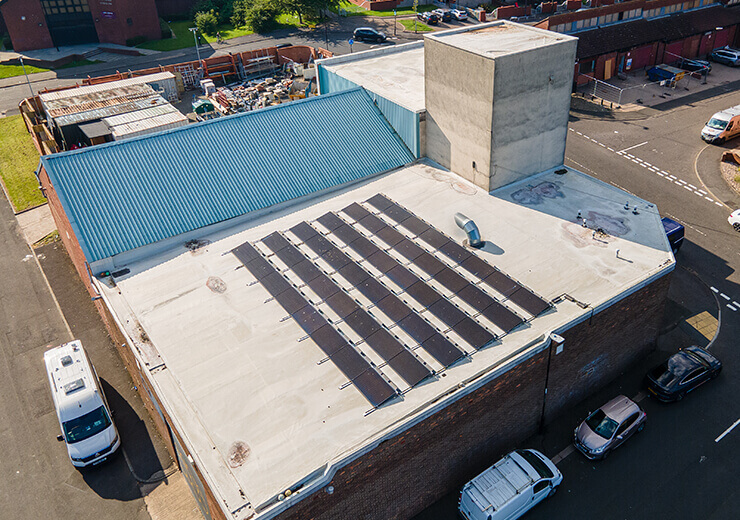
HSE guidance says all roofs should be treated as fragile until a competent person has confirmed otherwise, and identifies fragile rooflights as a particular hazard. On education estates with sheeted roofs or old rooflights, safe access, edge protection and fragile-surface controls are part of the solar project, not an installation-day afterthought.
Structural Capacity Is Not Just the Weight of the Panels
Solar adds permanent dead load, but the structure also needs to deal with wind actions and, depending on the roof and location, snow loading. Ballasted flat-roof systems can add substantially more permanent load than mechanically fixed systems. Older roofs may also have limited records or previous alterations that need investigation.
Approved Document A provides the statutory structural framework in England. On a real project, structural design can also depend on the roof manufacturer, mounting-system data and a site-specific engineer's assessment. We do not infer capacity from the fact that a roof has carried itself successfully for decades.
How Much Solar Should a School Install?
The maximum roof area and the optimum financial system size are not necessarily the same number. We compare annual and half-hourly consumption with predicted generation from each viable roof zone. Then we model how much electricity will be used directly, exported or, where appropriate, stored.
For education estates considering commercial solar PV, we also look beyond the current bill. A school that expects electric heating, new ICT infrastructure or staff and fleet EV charging may reasonably preserve expansion routes or install more generation now if the network and financial model support it.
G98, G99 and the DNO Connection
Network connection should be considered before the design is treated as final. The current GB distributed-generation connection guide distinguishes G98 microgeneration from larger G99 connections. For three-phase installations, the G98 threshold is based on combined registered capacity no higher than 16 A per phase, equivalent to 11.04 kW at nominal 230 V per phase; many school systems are therefore G99 projects.
That does not make larger school solar difficult by default, but it means the DNO has to be part of the programme. Export capability, transformer capacity and other generation or battery equipment on site can all affect the connection route.
Export Limitation Can Be Better Than Abandoning a Good Roof
If a DNO cannot accept the full theoretical export from an array, the answer is not automatically to make the PV array smaller. In some projects an engineered export-limitation scheme can cap the amount sent to the grid while allowing the site to use more generation behind the meter.
Whether that is worthwhile depends on the load profile. A school with high daytime demand may be able to install substantial PV with relatively modest export. A low-load site during summer may hit the export limit much more often. We model the actual behaviour before recommending that route.
Do Schools Need Battery Storage?
Not automatically. Strong daytime demand can mean a school already uses a high proportion of its solar directly, which can reduce the incremental value of storing that same energy. Batteries become more interesting where the site has expensive peak periods, substantial holiday/weekend export, resilience objectives, time-of-use opportunities or future flexible loads.
We also distinguish between energy capacity and power. A battery with plenty of kWh but insufficient kW may do little for a short high-demand peak. Conversely, a high-power battery can be underused if there is not enough energy value to cycle it regularly.
Funding and Ownership: Compare More Than the Upfront Price
The 2026 Great British Energy school programme demonstrates that public funding and third-party structures are part of the current education-solar landscape. Availability and eligibility are programme-specific, so we do not build a financial case around funding until the school knows what route is actually open to it.
Where a school is comparing direct capital purchase with a power purchase agreement or another funded structure, we want the comparison to include ownership of the equipment, tariff or PPA escalation, contract length, maintenance responsibility, roof-access rights, inverter and battery replacement, insurance, end-of-term arrangements and who receives export income.
A Low Upfront Cost Is Not the Same as the Lowest Lifetime Energy Cost
For an academy trust or school estate, the commercial question is how much value remains with the school over the full contract period. We compare retained bill savings and risk, not just the amount required in year one.
Installation Has to Work Around Safeguarding and the School Calendar
Education projects need a programme that controls access, deliveries, noise, scaffold, roof work and electrical shutdowns around pupils and staff. We plan site segregation and any distribution-board work with the school's operating team, and we prefer disruptive work to be scheduled when the estate can safely accommodate it.
That planning is part of the engineering quality. Rushing an array onto a roof during a narrow holiday window without resolving survey, DNO or structural issues first is not a sensible programme.
What Should the School Receive at Handover?
A commercial solar installation should leave the client with a clear record of what was built and how it should be operated. We expect drawings, equipment information, test and commissioning records, monitoring access, shutdown and isolation information, maintenance requirements and the applicable network documentation.
For larger estates, we also want responsibility for monitoring to be clear. If nobody reviews alarms or generation trends, a fault can remove part of the expected savings without becoming obvious on the electricity bill.
Use Solar as a Teaching Asset as Well as an Energy Asset
Where the school wants it, monitoring data can support STEM, sustainability and estates education. Real generation curves show the effect of season, cloud, orientation and demand in a way that a generic classroom example cannot. The priority remains safe operation, but the system can also make energy visible to pupils and staff.
What We Recommend Before a School Requests Final Prices
Our Pre-Quote School Solar Checklist
- At least 12 months of electricity data and, ideally, half-hourly consumption.
- Site plans and available roof drawings.
- Roof age, material, condition and warranty information.
- Known structural reports and asbestos information where relevant.
- Current electrical single-line information and main supply capacity.
- Details of existing generation, batteries or export controls.
- Planned building works, heat pumps or EV charging.
- Term dates, holiday use and community-use patterns.
- Funding route and decision-making timetable.
- Requirements for monitoring, reporting and curriculum display.
Our View: The Best School Solar Project Starts With the Estate, Not a Panel Count
Schools can make very strong use of solar, but the value comes from matching generation to the real building and operating model. We want the roof to remain serviceable, the electrical connection to be agreed, the summer export position to be understood and the financial model to show where the savings actually come from.
Our commercial solar case studies show the type of practical design and installation work we carry out across non-domestic properties.
Planning Solar for a School, Academy or College?
Send us your recent electricity data, site details and any roof information you already hold. We can assess the viable roof area, generation profile, DNO route and commercial options before turning the project into a final specification.