
Solar Performance vs System Design: What Actually Determines Output?
Author: Steve Fairless
Originally Published: 12th May 2026 · Updated: 2nd September 2026
Real-world solar performance is determined by the complete system design, not by the panel efficiency figure alone. The modules need suitable solar exposure, the strings must operate inside the inverter’s voltage and current limits, different roof faces need appropriate MPPT separation, the mounting must preserve ventilation and structure, and the generated electricity needs a useful route into the building, battery or grid.
At Sustainable Energy Engineering, we compare equipment only after we understand the roof, energy demand, electrical supply, shading and future plans. A premium panel cannot recover sunlight blocked by a chimney, correct an invalid string voltage or make an oversized battery useful.
This guide explains the design variables that shape annual generation, reliability and financial value, why two arrays with the same nominal kWp can perform differently and what customers should expect to see in a credible solar proposal.
What Determines Solar Performance? The Short Answer
- Solar resource comes first. Location, roof orientation, pitch, horizon and shade determine how much irradiance reaches the modules.
- Layout decides which roof area is useful. More panels are not automatically better if marginal modules are heavily shaded or force a poor string design.
- Electrical grouping matters. Modules sharing a string and MPPT should have compatible voltage, current and irradiance conditions.
- The inverter creates operating limits. DC voltage, input current, MPPT range, AC output and export restrictions all affect usable generation.
- Batteries change energy timing, not solar yield. Storage can increase self-consumption but cannot replace missing sunlight.
- Commissioning and monitoring protect the design. A strong forecast only has value if the finished installation is tested and its performance can be understood.
Start with Irradiance, Not the Panel Brochure
Solar panels convert the light that reaches them. The available solar resource therefore sets the upper boundary for the system. PVGIS uses long-term solar and weather data to estimate monthly and annual production for a selected location, module technology, mounting arrangement, orientation and inclination.
That model does not see every nearby chimney, tree, parapet or dormer. We combine location-based resource data with a site survey and a shade assessment so the forecast reflects the actual roof rather than an idealised open field.
Four Layers in a Defensible Yield Estimate
Why Identical Panel Counts Can Produce Different Results
Imagine two homes with ten identical modules. One array is on a clear south-west roof with compatible strings. The other is split across three roof sections, partly shaded and connected to an inverter with inadequate MPPT separation. Both may be advertised as the same kWp, but they do not have the same irradiance profile or electrical operating conditions.
Nominal capacity is useful for describing the array at standard test conditions. It is not a promise of annual energy. The design turns that label capacity into a site-specific generation profile.
Panel Efficiency Mainly Changes the Area Required
Module efficiency describes how much of the incident solar energy is converted into electricity under defined test conditions. Higher efficiency allows more wattage to fit within a limited roof area. It can be very valuable where the roof is small.
On a large roof, however, a slightly lower-efficiency module may deliver the required system capacity at a better whole-project cost. The correct comparison is not simply 22% versus 21%; it is installed kWp, expected annual kWh, product quality, degradation, warranty support, mechanical compatibility and total system price.
A Higher Percentage Does Not Create Better Sunlight
A high-efficiency module on a poor roof plane can produce less annual energy than a lower-efficiency module on a better plane. Efficiency helps us use area; orientation, pitch and shade determine how much energy reaches that area.
Roof Layout Is an Engineering Decision
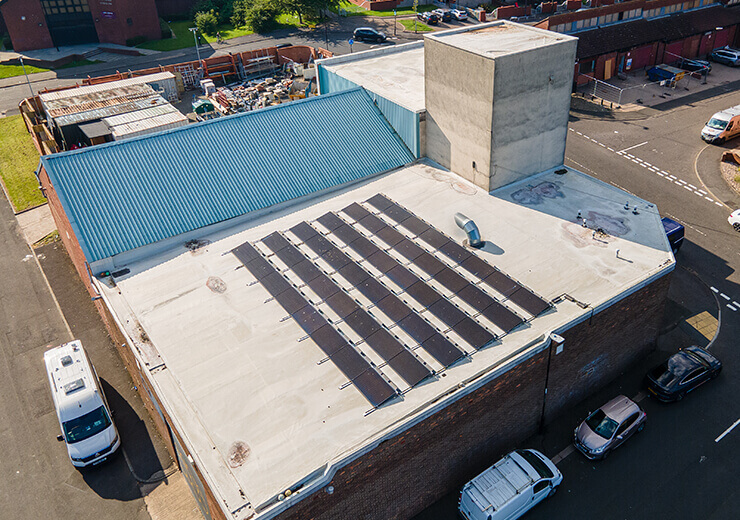
We aim to use the roof intelligently rather than fill every visible rectangle. Fire access, roof edges, drainage, maintenance routes, structural fixing zones, obstructions and wind exposure can remove areas that look available in an aerial image.
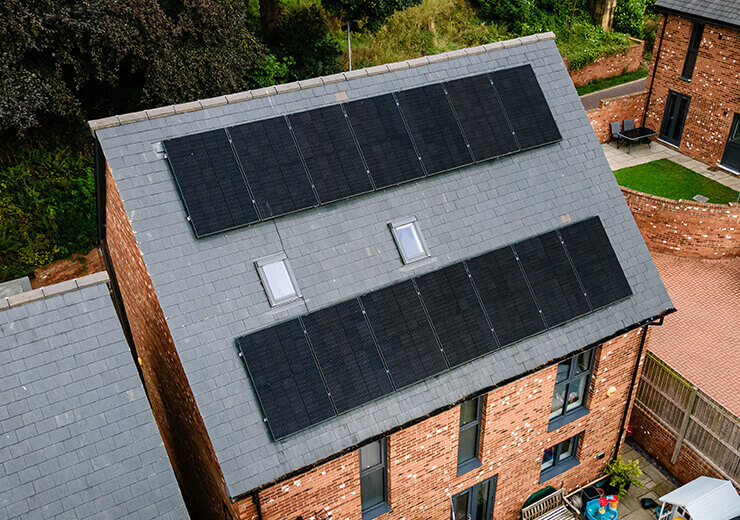
For solar PV for the home, we compare each roof face separately. An east-west layout may produce less per panel than a favourable south-facing plane but offer more total capacity and a broader daily generation profile.
| Design choice | What can go wrong | What we check |
|---|---|---|
| Module placement | Persistent shade or avoidable obstruction losses. | Sun path, seasonal shadow and alternative positions. |
| Roof-face grouping | Different orientations forced onto one operating point. | Separate strings and MPPT allocation. |
| String length | Voltage too low in heat or too high in cold conditions. | Module temperature coefficients and inverter limits. |
| Inverter rating | Excess clipping, weak low-light operation or unnecessary cost. | Simultaneous output profile rather than DC label total alone. |
| Battery sizing | Storage fills too early, rarely fills or cannot supply peak loads. | Half-hourly demand, surplus energy, charge/discharge power and reserve. |
| Monitoring | Faults or configuration errors remain unnoticed. | Generation, consumption, import/export and alert visibility. |
Shading Is Both an Energy and Electrical Problem
Shade removes irradiance from the affected cell area, but the electrical loss can also depend on cell interconnection, bypass diodes, string configuration and inverter tracking. A narrow shadow across a cell group can behave differently from soft, uniform low light.
Independent IEA PVPS work comparing optimised electronics and conventional string inverters shows why there is no universal “optimiser uplift”. The benefit depends on the pattern and severity of shade, the equipment and the system topology. Our first step is a better layout; electronics are used when they solve a defined mismatch problem.
Hardware Cannot Recover Missing Solar Radiation
Optimisers, microinverters and advanced MPPT algorithms can improve how mismatched modules operate. They cannot generate the energy that a tree or building prevented from reaching the array. The forecast must include the physical shade loss first.
String Voltage Can Decide Whether a Layout Works
Modules connected in series add voltage. The string must remain below the inverter’s maximum DC voltage during cold conditions, when open-circuit voltage rises, and above the minimum MPPT operating requirement during hot or weak-light conditions, when voltage falls.
This is why adding or removing one panel can change more than nominal capacity. On short roof sections, the visually neat layout may not create a valid electrical string. We would rather change the grouping or equipment than accept an unreliable operating window.
Modern Module Current Needs Careful Matching
Panel wattage has increased partly through higher current. Inverter datasheets therefore need checking for maximum operating current and short-circuit current on each input. Parallel strings can increase current even when their voltage remains similar.
A design based only on “the inverter accepts 6 kW of panels” can miss an input-current limit. We use the actual module and inverter electrical data, including temperature effects, rather than matching headline wattages.
MPPT Allocation Shapes Multi-Roof Performance
Maximum Power Point Tracking allows an inverter to adjust the electrical operating point of a connected string or group. Separate trackers are useful when roof faces have different orientations or irradiance profiles. East and west strings, for example, peak at different times.
Connecting electrically incompatible roof faces to the same tracker can force a compromise operating point. Multiple MPPTs are not automatically better if they are allocated poorly; the design must match each tracker’s voltage, current and start-up requirements.
Inverter Sizing Is Not a One-to-One Wattage Match
The array’s DC rating is measured under standard test conditions. Real output varies with weather, temperature and roof direction. A sensible DC-to-AC ratio can allow the inverter to operate efficiently across more hours, while occasional clipping may be cheaper than buying capacity used only during rare peaks.
Too much oversizing can create avoidable energy loss or breach equipment limits. Too little DC capacity can leave the inverter underused. We model the expected simultaneous output and check warranty and manufacturer design rules.
That relationship is more informative than one product percentage. Each term can be improved or degraded by design choices.
Export Limits Can Cap Otherwise Available Power
A DNO-approved export limit may require the system controller to reduce output when the property cannot consume or store the energy. This is not necessarily a poor design; export limitation can make a larger array possible where network capacity is constrained. But the financial model must include likely curtailment.
Battery charge power, flexible loads and daytime consumption can reduce export-limited losses. The controller and metering arrangement must also be commissioned correctly.
Batteries Improve Utilisation, Not Panel Generation
Battery storage can move surplus solar from midday into the evening, reduce imports and interact with time-of-use tariffs. It does not increase the kWh generated by the array. In fact, energy passing through storage experiences conversion and standby losses.
We size solar battery systems around usable surplus, demand timing, inverter power and tariff strategy. A battery should improve the value of the generated energy, not be used to hide an array that was poorly placed.
Installation Quality Protects the Designed Performance
A correct drawing can still be undermined by damaged connectors, poorly supported cables, incorrect string allocation, loose terminations, shading created by the finished layout or monitoring sensors installed in the wrong direction. Commissioning tests are where the installed system is compared with the design.
What We Verify Before Handover
- module quantities and roof positions match the final design;
- string polarity, voltage and current are plausible;
- inverter inputs and MPPT assignments are correct;
- protective devices, isolators, labels and earthing arrangements are complete;
- generation, consumption and import/export monitoring flow in the right direction;
- battery power, reserve and operating modes are configured as agreed;
- network settings and any export limitation operate correctly;
- the customer can recognise normal operation and key alerts.
Monitoring Should Compare Like with Like
One cloudy day is not evidence of poor design, and one record day does not prove annual performance. We compare monthly and annual generation with weather, orientation, downtime, shade and the system forecast. On multi-roof systems, separate string or MPPT data can reveal a persistent imbalance.
Our solar PV servicing work often begins with monitoring history because it helps distinguish a system fault from seasonal conditions or changes in household behaviour.
A Worked Comparison: More Efficient Panel vs Better Layout
Consider a roof that can fit ten 450 W modules in a clear layout, or eleven 430 W modules if one extra panel is squeezed beside a chimney. The first option is 4.50 kWp; the second is 4.73 kWp. The second has more label capacity, but the extra module and its electrical grouping may create shade and mismatch losses.
We would model both arrangements. If the larger layout produces only a small annual gain, complicates the string or increases installation cost disproportionately, the apparently “bigger” system may deliver weaker value. This is why capacity, annual yield and lifetime cost must be shown separately.
What a Good Proposal Should Allow You to Check
- Roof assumptions. Orientation, pitch, usable areas and obstructions should be clear.
- Array layout. The actual number and position of modules should be shown.
- Electrical design. Module, string, MPPT and inverter compatibility should be defensible.
- Yield estimate. Annual and preferably monthly generation should include shade and system losses.
- Energy-use model. Direct use, battery storage and export should reflect the customer’s demand.
- Constraints. Export limits, roof condition, planning, access or future expansion should be identified.
- Handover and aftercare. Monitoring, warranties, documentation and service responsibility should be explicit.
Our Conclusion: Performance Is Designed Before It Is Installed
The panel matters, but the performance of a solar installation comes from the decisions connecting the panel to the roof, inverter, electrical system, battery, grid and customer’s demand. Those decisions determine how much irradiance is captured, how efficiently energy is converted and how much of it creates value.
We therefore judge a design by expected usable annual energy, electrical validity, serviceability and long-term fit—not by the highest single efficiency percentage on a comparison sheet.
Want a Solar Design Built Around Your Property?
We can assess your roof, shading, electricity use, battery plans and network position, then explain the design assumptions before installation.