
Off-Grid Solar Project: What a Reliable Stand-Alone System Really Requires
Author: Steve Fairless
Originally Published: 30th November 2023 · Updated: 2nd September 2026
An off-grid solar system has to do more than generate a good annual total. It must supply the required loads at the moment they occur, store enough energy for nights and poor-weather periods, recover after a low-battery event and remain safe and serviceable without relying on the public electricity network. That is why off-grid design starts with demand, autonomy and failure planning rather than simply fitting as many panels as possible.
At Sustainable Energy Engineering, we helped Richard Thew from the Thousand Yard Stare YouTube channel with an off-grid solar project. The video below shows the project and gives a useful view of how a stand-alone system comes together.
This guide builds on that project by explaining the engineering decisions that matter on any off-grid installation: daily energy use, surge power, winter solar resource, battery reserve, inverter capability, backup generation, load priorities, monitoring and maintenance.
Off-Grid Solar: The Short Answer
- Annual generation is not enough. A system can produce more kWh over a year than the site consumes and still run out of energy during a dark winter week.
- Battery capacity and inverter power are different. kWh determines how long loads can run; kW determines which loads can run together.
- Winter normally sets the design challenge. Short days, lower sun and poor weather create the largest generation deficit.
- Critical and discretionary loads should be separated. Lighting, communications and controls may need priority over heating, cooking or workshop equipment.
- Backup is part of resilience. A generator or other secondary source can be more economical than oversizing solar and batteries for the rarest conditions.
- Monitoring is essential. State of charge, solar yield, load power and fault history need to be understandable before a problem becomes an outage.
What “Off Grid” Actually Means
A true off-grid installation has no normal electrical connection to the public distribution network. It creates its own local electrical system using one or more sources, usually solar PV, battery storage and an inverter/charger. Some sites add a generator, wind turbine or other source for seasonal support.
This is different from a grid-connected home with backup circuits. A backup-capable battery can keep selected loads running during a power cut, but the property still uses the grid in ordinary operation. An off-grid system has to balance supply and demand continuously because there is no grid to absorb surplus or cover a deficit.
Grid-Connected Solar with Backup
- the grid covers shortfalls;
- surplus may be exported;
- backup may serve selected circuits;
- tariffs influence operation.
True Off-Grid Solar
- all normal energy is produced on site;
- surplus must be stored, used or curtailed;
- deficits require load reduction or another source;
- the local inverter forms the electrical supply.
Start with a Load Audit, Not a Panel Count
The first calculation is how much electricity the site uses and when. We list every meaningful load, its running power, start-up or surge demand, expected daily operating time and whether it is essential. A fridge may use modest energy over a day but start repeatedly. A kettle uses high power for a short time. Electric heating can dominate both power and energy.
| Load characteristic | Question we ask | System consequence |
|---|---|---|
| Daily energy | How many kWh does the load use in a typical and worst-case day? | Influences PV and usable battery capacity. |
| Continuous power | What loads may run together? | Sets normal inverter output and cable/protection requirements. |
| Starting surge | Does a motor, pump or compressor draw a short high current? | Can require greater inverter surge capability. |
| Seasonal use | Is the load highest when solar generation is lowest? | May make winter autonomy much harder. |
| Criticality | Can the load be delayed or disconnected? | Shapes load-shedding and backup priorities. |
A load audit should use measured data where possible. Plug-in energy meters, inverter logs or half-hourly records are more reliable than appliance labels alone because real duty cycles differ.
Battery Capacity: Usable Energy, Not the Label Alone
Battery capacity is measured in kilowatt-hours, but the full nominal capacity is not normally available for daily use. The battery management system, minimum state of charge, temperature, ageing and any emergency reserve reduce the energy that can be drawn.
That formula is only a starting point. We then consider recharge rate, seasonal solar, low-temperature operation, battery warranty and whether occasional generator support is acceptable. A battery that can run the site for two summer nights may not provide two winter days if the daytime array contributes very little.
Our wider solar battery storage work uses the same distinction between usable kWh and power, but off-grid systems place a much higher penalty on getting it wrong.
Why Inverter Power Can Be the Hidden Constraint
The inverter creates the AC supply and must support the combined live load. It also needs enough short-duration capability for motors, pumps, refrigeration or tools. An oversized battery does not solve an inverter that cannot start the equipment.
A 10 kWh Battery Does Not Mean 10 kW of Power
Energy capacity tells us how long a load may run. It does not tell us whether the inverter can supply a shower, kettle and pump at the same time. We check continuous output, surge output, phase arrangement, power factor and the battery’s own current limits.
Winter Solar Resource Usually Sets the Hardest Case
PVGIS provides location-specific estimates of monthly solar production and also includes an off-grid assessment tool. We use monthly and daily patterns to understand the seasonal gap rather than dividing an annual kWh forecast by 365.
A system sized around a sunny annual average can fail in winter because generation is concentrated in spring and summer. The more electricity a site uses for heating, dehumidification or long lighting hours, the more the demand curve can move in the opposite direction to solar production.
Three Forecasts We Want to See
- Expected monthly generation: shows the seasonal shape and identifies the weakest months.
- Low-sun sequence: tests how the battery behaves across several poor days rather than one average day.
- Recovery case: shows whether the array and charger can refill the battery while still supplying essential loads.
Autonomy Days Are a Choice, Not a Universal Standard
Autonomy describes how long the site can run without useful renewable input. More autonomy means more battery capacity and cost. The correct target depends on access, criticality, occupancy, climate and whether a generator can be used.
A remote communications site may need a high level of redundancy. A cabin used occasionally can tolerate stronger load management. A workshop may accept that high-power machinery only runs when the battery and solar conditions are favourable.
Why a Generator Can Improve the Overall Design
Customers sometimes see a generator as evidence that solar has failed. We see it as one possible resilience tool. Designing enough PV and battery capacity to cover a rare sequence of exceptionally poor winter days can be disproportionately expensive and may leave equipment underused for most of the year.
A correctly integrated backup generator can start manually or automatically at a defined battery threshold, supply critical loads and recharge storage. The design must still address fuel, ventilation, noise, maintenance, safe changeover, earthing and the inverter/charger’s input limits.
Load Priorities Protect Essential Services
Off-grid resilience improves when the installation can distinguish essential loads from deferrable ones. We may separate circuits, use contactors or smart controls, and provide clear operating rules for the owner.
A Practical Load-Priority Order
- communications, alarms and essential controls;
- basic lighting and refrigeration;
- water, heating controls or pumps where safety depends on them;
- general sockets and normal appliances;
- high-energy discretionary loads such as immersion heating, workshop tools or EV charging.
The exact order is site-specific. The important point is that one discretionary appliance should not silently remove energy reserved for an essential service.
What Happens When the Battery Is Full
Without a grid export route, surplus solar must be used, curtailed or diverted. The inverter can reduce PV production once the battery is full and loads are satisfied. Some systems use controlled diversion to water heating or another flexible load, but that load should not compromise battery recovery or thermal safety.
Surplus in summer does not compensate for a winter deficit. It simply shows that the array has more available energy than the site can use at that moment.
What Happens When the Battery Is Low
The system should respond before the battery reaches a damaging state. Options include warning the owner, disconnecting non-essential circuits, starting a generator or shutting down in a controlled way. The restart sequence matters because a deeply depleted system may not have enough power to energise every load at once.
We agree these behaviours during design and commissioning. A low-battery event should not be a mystery the first time it happens.
Mounting, Weather and Access Still Matter
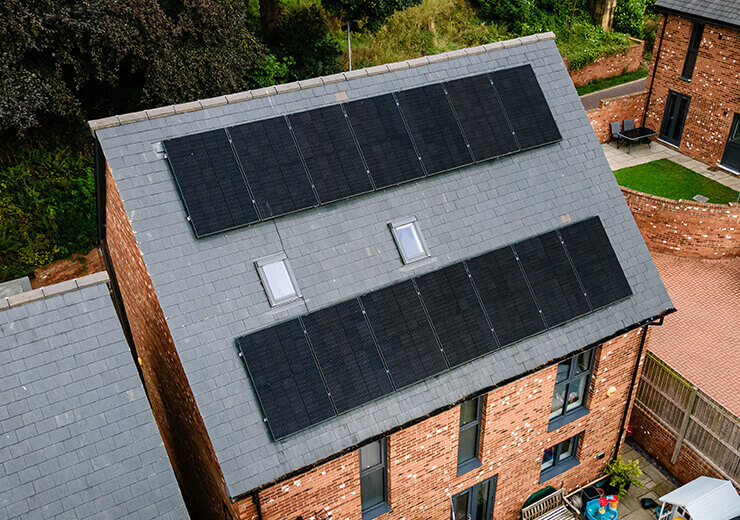
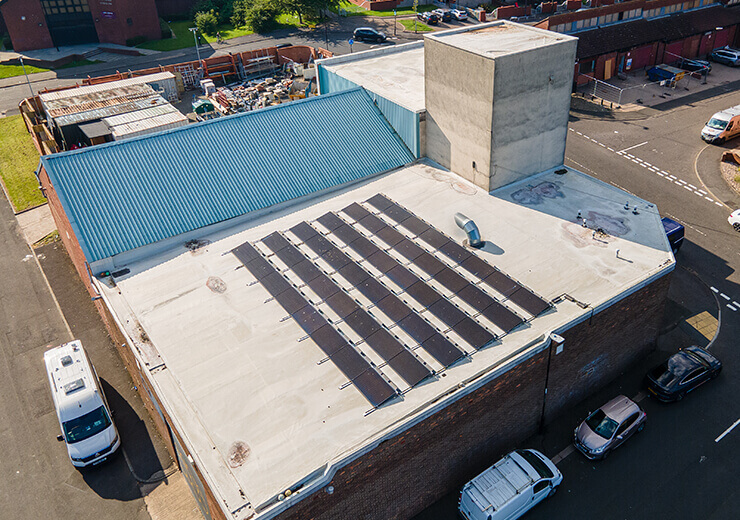
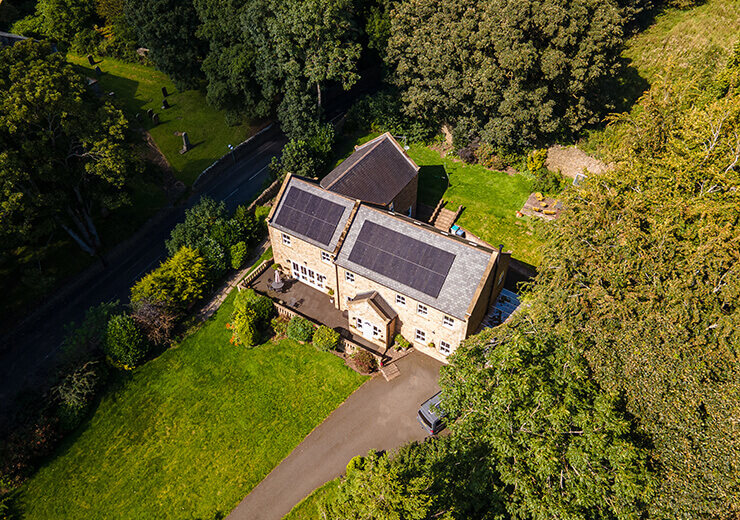
An off-grid array may be on a roof, ground frame or outbuilding. The mounting structure must remain stable and durable through wind, rain, corrosion and snow. Cable routes, isolators and equipment enclosures need to suit the environment and remain accessible for inspection.
For a normal home or building project, our solar PV design approach begins with the same building and electrical fundamentals. The difference off grid is that every avoidable fault has a greater operational consequence.
Monitoring Turns an Off-Grid System into a Manageable Asset
The owner should be able to see solar generation, battery state of charge, load power, energy history, generator operation and alarms. Trends reveal whether consumption is rising, the battery is recovering fully or a seasonal adjustment is needed.
State of Charge Is Not a Fuel Gauge with Perfect Accuracy
Battery systems estimate state of charge from voltage, current and internal models. Calibration can drift and conditions affect the estimate. We look at the trend, minimum levels, charge completion and energy throughput rather than relying on one percentage in isolation.
Maintenance Planning Is Part of Off-Grid Design
Panels, mounting, cables, connections, batteries, inverters and generators all have different maintenance needs and service lives. The site should have safe access, clear labels, isolation instructions, spare-part information and contact details.
We also plan for component replacement. A battery or inverter may need attention before the array reaches the end of its useful life. Modular access and documented settings reduce the risk that one replacement becomes a complete redesign.
What the Thousand Yard Stare Project Demonstrates
The project is valuable because it shows off-grid solar as a complete system rather than a single product. Generation, storage, conversion, mounting and the user’s actual purpose have to work together.
Our solar video case studies help customers see the physical reality behind system diagrams: equipment takes space, cable routes matter, arrays need secure mounting and operating decisions continue after commissioning.
Our Off-Grid Design Checklist
- Measure daily and peak demand. Identify loads, run time, surge current and seasonal changes.
- Define essential services. Decide what must continue through a low-generation period.
- Model solar by month. Design around the weak season, not the annual average.
- Choose an autonomy target. Balance battery size against load management and backup generation.
- Check inverter and battery power. Confirm continuous and surge performance for real combinations of loads.
- Design charging and backup. Ensure the system can recover after poor weather.
- Plan protection and earthing. Treat the local supply as an electrical system requiring competent design.
- Commission controls and alarms. Test low-battery, generator and load-shedding behaviour.
- Train the owner. Explain normal operation, limits, maintenance and what to do when conditions are poor.
Our Conclusion: Off Grid Is an Energy-Balance Discipline
A reliable off-grid solar system is designed for the days when generation is weakest and demand cannot simply be transferred to the public grid. The array, battery and inverter must be sized together, and the owner needs a clear plan for surplus, low state of charge, high-power loads and backup.
More equipment is not automatically the answer. Measured demand, sensible load priorities, location-specific solar data and a maintainable architecture produce a stronger result than an oversized system built from optimistic annual averages.
Planning a Stand-Alone or Resilient Solar System?
Tell us what the site needs to power, where it is located and how critical uninterrupted operation is. We can assess the load, generation, storage and backup strategy together.