
North-Facing Solar Panels: Are They Worth Installing in the UK?
Author: Steve Fairless Originally Published: 16th August 2026 · Updated: 2nd September 2026
North-facing solar panels can be worth installing in the UK, but they need more careful modelling than south-, east- or west-facing arrays. A shallow north-facing roof can still receive substantial diffuse and high-summer solar radiation, while a steep due-north roof can lose a large proportion of annual yield. The answer depends on pitch, exact azimuth, shading, available roof area, system cost and how valuable the generated electricity is to the household.
At Sustainable Energy Engineering, we do not automatically reject a north-facing roof and we do not pretend it performs like a south-facing roof. We calculate what that specific roof is likely to deliver and compare it with alternative roof planes, outbuildings, layout changes and the customer's energy goals.
This guide explains why pitch matters so much, how diffuse light changes the UK picture, when extra panel area can compensate for weaker orientation, and when we would advise leaving a north roof empty.
Are North-Facing Solar Panels Worth It? The Short Answer
- Shallow north-facing roofs can be viable. The closer a roof is to horizontal, the less severe the orientation penalty becomes.
- Steep due-north roofs are the hardest case. They receive much less direct solar radiation during the productive part of the year.
- North-east and north-west can be materially better than due north. Exact azimuth matters.
- Large clear roof area can change the economics. More installed kWp can sometimes outweigh lower yield per panel.
- Shade still matters. A north-facing roof that is also shaded can become a poor investment quickly.
- A battery does not fix weak generation. Storage can shift energy in time, but it cannot create solar energy that the array did not produce.
Why North-Facing Panels Produce Less in the UK
The UK is in the northern hemisphere, so the sun is predominantly in the southern part of the sky. A tilted south-facing module points towards that solar path. A tilted due-north module points away from it, reducing direct irradiance on the panel surface.
The loss becomes more severe as the north-facing roof gets steeper because the panel plane turns further away from the sun. On a very shallow roof the module is closer to horizontal, so compass direction matters less.
A Legacy Ofgem Table Shows Why Pitch Matters — But We Do Not Use It as a Forecast
Ofgem’s 2018 ECO2t solar-PV scoring methodology grouped orientation and inclination combinations into bands of 35%, 55%, 74%, 86%, 93% and 100%. We keep it here only because it makes one design principle very clear: orientation cannot be separated from roof pitch. It is a legacy scheme methodology, not a 2026 performance forecast.
In that table, a due-north array around 30–35 degrees falls in the 55% band, while a horizontal array falls in the 86% band. We do not quote either figure to a customer as an expected yield. For a live design we use current location-specific modelling such as PVGIS, but the contrast explains why the phrase “north-facing” is incomplete unless the roof pitch is also known.
Ofgem Legacy Orientation-Inclination Bands
Source: Ofgem ECO2t Solar PV Scoring Methodology v1.0, orientation and inclination table. The bands are a legacy scoring method and should not replace a current site-specific yield calculation.
Diffuse Light Is Why North-Facing Panels Still Generate
Solar PV uses both direct and diffuse irradiance. On an overcast day, sunlight is scattered through the sky rather than arriving only as a sharp beam from the sun. A north-facing module can therefore generate even when it never receives the same direct exposure as a south-facing module.
This is particularly relevant in the UK climate, but diffuse light does not remove the orientation penalty. The annual result still depends on how much total irradiance reaches the panel plane.
Roof Pitch Is the Critical Variable
| North-facing pitch | Initial design view | What we check next |
|---|---|---|
| Very shallow | Can be viable because the panel plane is close to horizontal. | Drainage, self-cleaning, mounting, wind and annual yield. |
| Shallow to moderate | Worth modelling if the roof is large and clear. | Exact azimuth, shading and whether other roof faces are available. |
| Typical pitched roof around 30-40 degrees | Material annual-yield penalty expected. | Financial return, panel count and alternatives. |
| Steep due north | Usually a weak first choice. | We would look hard for east, west, south, garage or ground-mount options first. |
North-East and North-West Are Not the Same as Due North
A roof described casually as "north-facing" may actually be north-east or north-west. That matters. North-east can receive useful direct sun in the morning during parts of the year; north-west can pick up later-day sun. The closer the azimuth moves towards east or west, the more the profile changes.
We therefore measure the roof rather than relying on an estate-agent description or a visual glance from the road.
When a Bigger North Roof Can Beat a Small South Roof
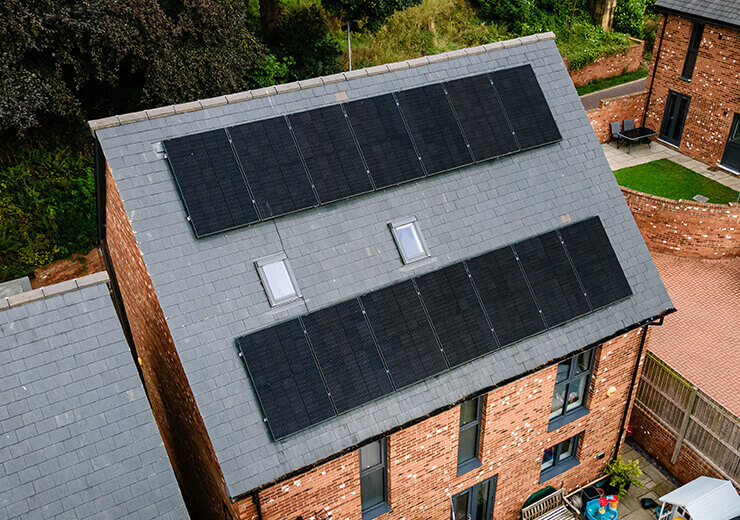
A common real-world comparison is not ten south-facing panels versus ten north-facing panels. It might be four modules on a small south dormer versus fourteen modules on a large clear north slope. Even with lower yield per module, the much larger array can produce more total annual electricity.
That is why solar PV for the home should be designed around usable kWp, not just orientation. We compare all roof planes and make the panel-count trade-off explicit.
Worked Example: Capacity Can Offset Lower Yield per kWp
Consider an illustrative index rather than a site forecast. If a small south roof can take 2.0 kWp at a reference yield of 100 units per kWp, it produces 200 indexed units. If a shallow north roof can take 4.0 kWp at 74 units per kWp, it produces 296 indexed units. The north modules are individually weaker, yet the larger roof produces more total energy in this simplified comparison.
This Does Not Mean "Double the Panels and North Is Fine"
Real project economics include module, mounting, scaffold, inverter and labour cost. The roof also has exact local irradiation and shading. The example only demonstrates why total usable array size must be compared with per-panel yield.
Shading Is More Damaging When Orientation Is Already Weak
If a north-facing array already receives reduced direct irradiance, adding tree or building shade can remove a larger share of the useful energy that remains. We are therefore cautious about using a north roof that also has tall obstacles on the northern horizon or heavy local shading.
Optimisers can manage module mismatch, but they cannot replace the missing sunlight. Good layout and honest yield modelling come first.
Would a Battery Make North-Facing Solar Worthwhile?
A battery can improve self-consumption by moving solar electricity from the time it is generated to the time the house needs it. It does not improve the array's solar yield. If the north-facing array is too weak, adding storage cannot solve the fundamental generation shortfall.
For solar PV with battery storage, we first establish how much energy the roof can reasonably generate. We then size storage around surplus energy and demand, not the other way around.
North-Facing Solar and Electric Vehicles
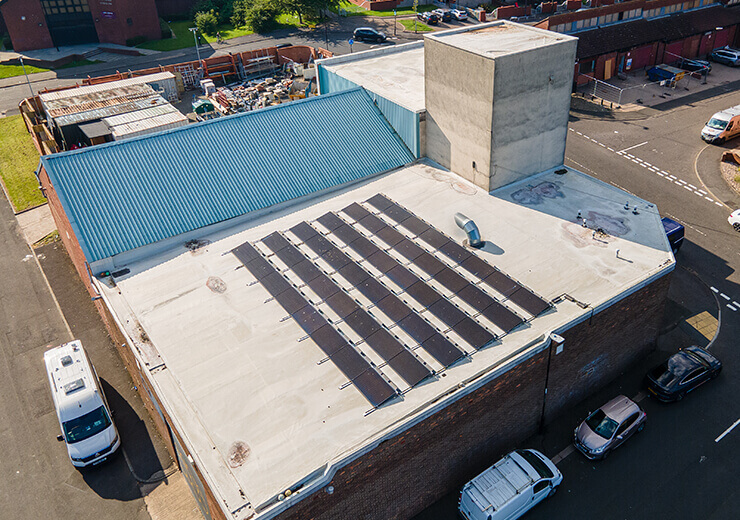
An EV can increase the value of a larger PV array because it creates a flexible daytime load. If a large shallow north roof allows significantly more panels, the extra total kWh may be useful even though each panel produces less than on a south roof.
Smart charging is important. The car needs to be available when solar is generating, or a battery/tariff strategy must shift the energy economically.
North-Facing Solar and Heat Pumps
Heat pumps use electricity across the heating season, when solar yield is lower for every orientation and especially constrained on steep north-facing roofs. We would not size the PV system by assuming it can cover winter heat-pump demand.
Solar can still offset annual electricity use, but a realistic monthly model is essential so summer surplus is not mistaken for winter self-sufficiency.
Does Panel Efficiency Solve the Orientation Problem?
Higher-efficiency modules can fit more kWp into a limited roof area, which helps when space is the constraint. They do not change the direction of the roof or the solar radiation reaching it. A premium panel on a poor surface may still generate less than a standard high-quality panel on a better surface.
We prioritise roof resource, layout and system design before chasing a small module-efficiency difference.
When We Would Seriously Consider a North-Facing Array
Positive Signals
- The roof is shallow rather than steep.
- There is little or no shading.
- The north roof is substantially larger than the alternatives.
- The household has high daytime demand, an EV or a heat pump.
- The additional panels share scaffolding and electrical infrastructure with a stronger main array.
- Site-specific modelling still shows an acceptable lifetime return.
- The inverter has suitable MPPT capacity for the additional orientation.
When We Would Usually Advise Against It
Warning Signals
- A steep due-north roof with limited annual irradiance.
- Significant tree or building shade on top of the orientation penalty.
- A very small north roof that adds little useful capacity.
- High extra installation cost for a separate scaffold or electrical route.
- A better east, west, south, garage or ground-mount option is available.
- The financial case only works if unrealistic generation assumptions are used.
What About Solar Panel Servicing on North-Facing Arrays?
Performance monitoring is valuable because weak orientation can make faults less obvious. A gradual problem may be mistaken for "that's just the north roof" unless the expected baseline is known. Periodic solar panel servicing can compare actual string performance, inspect connectors and mounting, and identify abnormal losses.
Our North-Facing Solar Design Process
- Measure exact azimuth and pitch.
- Map the local horizon and shade sources.
- Count usable modules after roof clearances and obstructions.
- Model annual and monthly generation for the north plane.
- Compare alternative roof faces on the same basis.
- Assess whether extra panel capacity offsets lower yield per kWp.
- Check MPPT/string voltage and current design.
- Model household use, export and any battery strategy.
- Compare lifetime value rather than headline panel count.
Seasonality Is Usually More Pronounced on a North-Facing Roof
North-facing generation in the UK is not distributed evenly through the year. During the brighter months, the high solar path and long daylight period allow a north-facing surface to receive useful diffuse light and, depending on pitch and exact aspect, some direct solar energy during parts of the day. In winter the sun remains low in the southern part of the sky, so a steep due-north roof can have a much weaker direct-sun opportunity.
This means an annual kWh total alone can hide an important design issue: a north-facing array may be most productive in the months when solar is already abundant and least productive when household electrical demand is high. We therefore look at monthly and hourly output, not just the yearly number.
A Shallow North Roof Is Very Different From a Steep North Roof
Pitch changes how much of the sky a module "sees" and how directly the surface faces away from the sun. As the roof becomes shallower, the penalty for facing north generally reduces. At very low tilt, the compass direction becomes much less important than it is on a steep pitched roof because the panel is closer to horizontal.
Why the Legacy Ofgem Bands Are Useful as a Geometry Illustration
The historic Ofgem table used broad orientation-and-inclination bands rather than one blanket "north" factor. In that table, a flat 0-degree array sat in an 86% band regardless of compass direction, while a due-north roof around 30–35 degrees sat in the 55% band. The purpose of citing those old bands here is not to predict a modern system; it is to show that pitch materially changes the north-facing penalty.
Source: Ofgem ECO2t deemed scores / solar PV orientation and inclination table, retained here as a legacy geometric reference rather than a current yield calculator.
North-Facing Arrays Need a Stronger Economic Case
When orientation reduces yield per installed kWp, fixed project costs are spread across fewer generated kilowatt-hours. That does not automatically make the project uneconomic, but it raises the importance of installation cost, usable roof area, shading, electricity value and expected ownership period.
We compare a north-facing proposal with realistic alternatives. These might include using only an east, west or south roof section; installing a smaller high-yield array; combining multiple orientations; improving self-consumption with load shifting; or leaving the weakest roof plane unused. The correct comparison is the best available design for the property, not north-facing solar versus having no electricity demand.
Diffuse Irradiance Helps, but It Should Not Be Oversold
The UK receives a meaningful share of solar energy as diffuse sky radiation, which is why modules can generate on cloudy days and why north-facing roofs are not completely unproductive. However, diffuse light does not erase the advantage of a surface that also receives stronger direct irradiance at a favourable angle.
Cloudy Weather Does Not Make Every Direction Equal
It is sometimes claimed that because the UK is cloudy, orientation barely matters. That is too simplistic. Diffuse conditions narrow the difference at certain times, but annual performance still depends on orientation, pitch, horizon, local climate and shading. We model the actual geometry rather than assuming cloud cover cancels it out.
What a Proper North-Facing Forecast Should Show You
Before We Recommend the Installation
- the exact azimuth rather than the vague label "north-facing";
- roof pitch and the number of modules that can be installed safely;
- annual and monthly kWh prediction for each roof plane;
- near-object and horizon shading assumptions;
- the yield in kWh per installed kWp so different roof options can be compared fairly;
- expected direct self-consumption, battery charging and export;
- the effect of any alternative east, west, south-east or south-west roof space; and
- a clear financial comparison based on realistic electricity values rather than an optimistic percentage claim.
If a proposal simply says "north-facing panels still work" without quantifying the expected annual and seasonal output, there is not enough information to judge whether that particular installation is worthwhile.
Bottom Line: North-Facing Solar Is a Modelling Question, Not an Automatic No
A steep due-north UK roof is usually one of the least productive places to put solar panels, but a shallow, large and unshaded north roof can still be commercially sensible. Exact pitch is crucial, and total usable array size can sometimes offset lower energy per panel.
Have a North-Facing Roof and Want a Real Answer?
We can compare the north roof with every other usable surface and show the expected energy before you commit. request a solar quote and we will base the recommendation on the numbers.