
How Roof Pitch Affects Solar Panel Performance
Author: Steve Fairless
Originally Published: 12th July 2026 · Updated: 3rd September 2026
Roof pitch affects how directly sunlight reaches a solar panel, so it changes annual generation and the balance between summer and winter output. It does not create one universal “perfect angle” for every UK property. Orientation, latitude, shading, horizon, usable roof area, module spacing, wind loading and the customer’s demand profile all interact with tilt.
At Sustainable Energy Engineering, we model the roof that exists before deciding whether its pitch needs changing. A well-sized array on a sound 25-degree roof may be a much better project than a smaller array forced to an “ideal” angle using extra frames, ballast and spacing. The engineering answer is based on total useful energy, not one geometric number.
This guide explains why pitch matters, when it matters most, how flat and north-facing roofs change the calculation and what we consider before recommending a mounting angle.
What Is the Best Roof Pitch for Solar Panels? The Short Answer
- There is no single best angle for every site. Location, direction, horizon and energy use change the optimum.
- Typical pitched roofs can perform very well without alteration. Small tilt differences often matter less than shade or lost panel area.
- Steeper tilt favours lower sun. It can improve the relative winter profile but may reduce high-summer capture.
- Shallower tilt favours higher sun. It can support summer output and fit naturally on low-pitch roofs.
- Flat roofs need a complete layout design. Tilt, row spacing, ballast, wind, drainage and maintenance access are linked.
- North-facing pitch is especially important. A shallow north roof can be viable; a steep due-north roof is usually much weaker.
Pitch, Tilt and Orientation Are Different
Roof pitch or module tilt is the angle above horizontal. Orientation, sometimes called azimuth, is the compass direction the panel faces. A 30-degree south-facing array and a 30-degree north-facing array have the same tilt but very different exposure to the UK sun path.
We therefore never assess pitch in isolation. Our home solar design maps each roof plane by angle and direction, then adds local shade and horizon information. That produces a site-specific energy profile rather than a generic percentage.
Useful Current Reference Points
These are broad consumer reference points, not a replacement for modelling the exact property.
Why the Sun Angle Changes Through the Year
The sun is higher in the sky during summer and lower during winter. A shallow panel plane aligns more favourably with high summer sun, while a steeper plane presents a more direct surface to lower seasonal sun. Cloud and diffuse irradiance soften the relationship but do not remove it.
That means “maximum annual kWh” and “strongest winter proportion” are not always achieved at exactly the same tilt. A customer with a heat pump may value winter generation differently from a business whose peak electricity use occurs in summer. We decide what the system is being optimised for before adjusting the mounting geometry.
How Much Does a Small Pitch Difference Matter?
Across a broad useful range, modest changes in tilt can produce relatively small annual differences compared with major shading, a poor compass direction or losing several modules. This is why we are cautious when a proposal adds complex frames solely to move a conventional pitched roof by a few degrees.
The extra structure can increase cost, wind loading, visual impact and maintenance requirements. If the same roof can hold more modules flush-mounted, total system generation may be higher even if each module is a fraction away from the theoretical optimum.
The Best Angle Is Not Always the Best System
We compare the complete layout. One “perfectly tilted” row with large gaps can generate less than a well-designed, lower-profile array that uses the available roof safely and avoids inter-row shading.
Typical UK Pitched Roofs
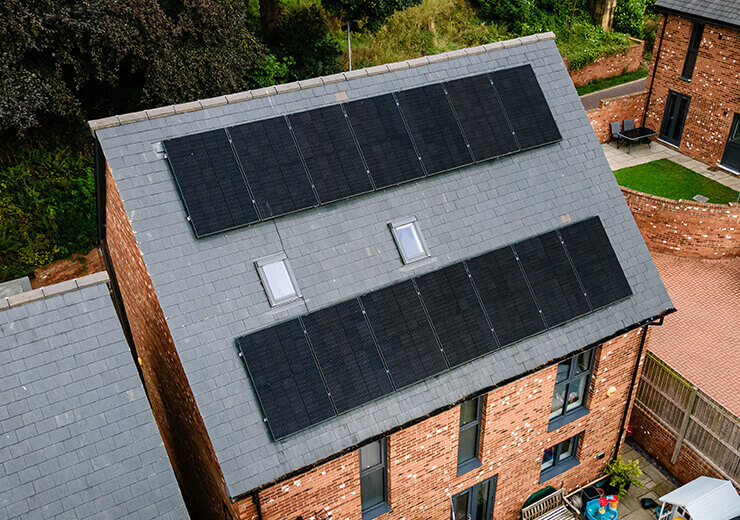
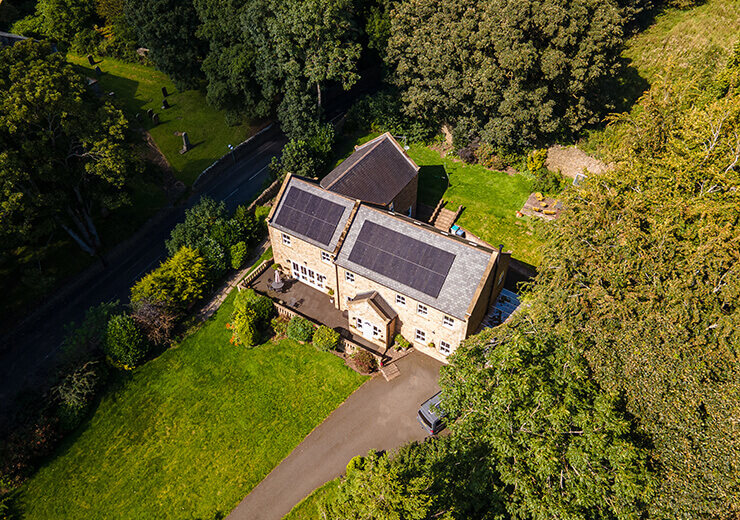
Many UK homes have roof pitches within a range that works effectively for solar. Where the covering and structure are suitable, following the existing plane is usually the most practical solution. It preserves a low profile, simplifies mounting and avoids creating extra wind exposure.
We still check cold-weather string voltage, cable routes, roof-edge zones, drainage and access. Pitch influences how water, debris and snow move across the modules, but the installation detail must also preserve the roof’s own weathering system.
Shallow-Pitch Roofs
A shallow roof can produce strong annual energy, particularly where it faces south, south-east or south-west. The main concerns are not simply yield: low inclination can increase soiling retention, slow water drainage and make local shading from parapets or nearby objects more persistent across the panel surface.
We confirm that the mounting method is approved for the roof and module, that the panel manufacturer’s minimum installation angle is respected where specified and that water does not collect against frames, clamps or cable loops.
Steep Roofs
A steep south-facing roof can capture lower sun well and shed rain and debris effectively. It may produce a relatively stronger shoulder-season and winter profile than a shallow array. However, summer incidence can be less favourable and access, scaffold and installation handling may be more demanding.
On a steep east or west roof, the time-of-day profile becomes pronounced. We model whether the morning or afternoon generation aligns with the building’s demand rather than dismissing the roof because annual kWh per panel is below a south-facing reference.
Pitch Makes a Major Difference on North-Facing Roofs
As a north-facing roof becomes steeper, the module plane points further away from the southern solar path. A shallow north roof is closer to horizontal and can receive more diffuse and high-summer irradiance. A steep due-north roof is usually one of the least productive conventional roof positions.
We compare the exact azimuth, not the estate-agent label. North-east and north-west can receive direct morning or evening sun at times of year, while true north does not behave the same way. Roof size can also matter: a large shallow north face may hold enough capacity to compete with a very small south roof.
Flat-Roof Solar Is a Layout and Structural Exercise
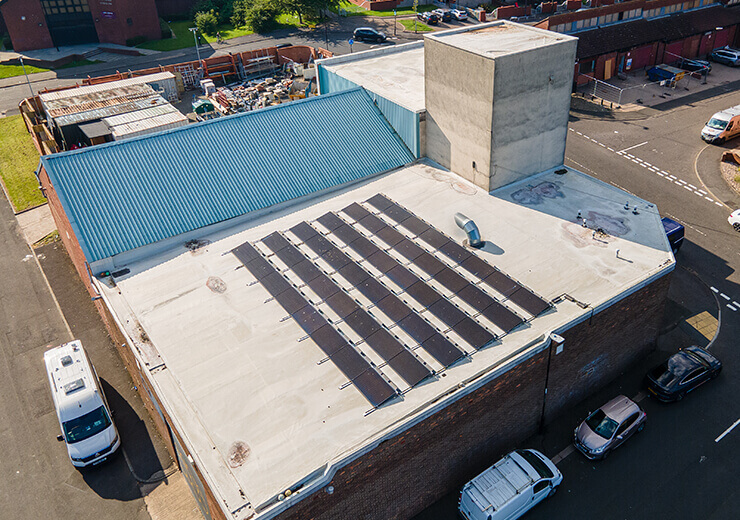
On a flat roof, we can choose the module tilt, but that freedom creates more variables. Increasing angle can improve incidence at some times while increasing wind loads, ballast or fixing demand, row spacing and visual prominence. Lower tilt can fit more capacity but may raise soiling and drainage concerns.
For commercial solar projects, we coordinate the array with roof zones, drainage outlets, plant, rooflights, fire access, walkways and membrane warranties. The highest-yield angle on an empty drawing may not be buildable once these constraints are included.
| Mounting condition | Potential advantage | What we check |
|---|---|---|
| Low-pitch roof | Good use of high summer sun and low visual profile. | Drainage, soiling, approved minimum angle and local shade. |
| Typical pitched roof | Usually efficient flush mounting with good annual performance. | Orientation, roof condition, edge zones and string design. |
| Steep roof | Stronger relative low-sun capture and good shedding. | Access, wind, seasonal profile and exact azimuth. |
| Flat-roof tilted frames | Ability to choose direction and inclination. | Row shade, ballast/fixings, membrane, wind and maintenance routes. |
| Shallow north roof | Closer to horizontal, with useful diffuse and summer irradiance. | Annual yield, roof area, shade and economics. |
| Steep north roof | Limited practical advantage. | Alternative roof faces, outbuildings or ground mounting first. |
Inter-Row Shading Can Cancel the Benefit of Extra Tilt
Tilting rows on a flat roof creates a raised northern edge. The next row must be far enough away to avoid unacceptable shade, particularly when the sun is low. A steeper angle therefore needs more spacing and can reduce the number of modules that fit.
We model row-to-row shade through the year and compare annual energy from the complete roof. A design with fewer high-tilt panels may not outperform a denser low-tilt layout once total kWp is included.
Wind Loading and Roof Zones
Raised modules experience aerodynamic forces that depend on building height, location, roof position, array shape and edge distance. Corners and roof edges can be more demanding. Ballast is not simply added until the frame feels heavy; the structural capacity of the roof and the mounting manufacturer’s design method must be satisfied.
MCS MIS 3002 requires building suitability, mounting and structural considerations to be addressed. On existing roofs, we also check whether the chosen method affects any roof or membrane warranty.
Pitch and Natural Cleaning
Rain usually removes loose dust from adequately tilted panels, and Energy Saving Trust uses 15 degrees as a broad reference for rainfall helping to keep modules clean. That does not mean every panel above 15 degrees will remain clear. Bird fouling, sap, lichen, coastal deposits and sheltered positions can still create local contamination.
We assess cleaning need from measured performance and safe visual evidence. Cleaning should never involve unplanned roof access, abrasive products or pressure methods that could damage seals, glass coatings or electrical components.
Using PVGIS to Model the Exact Roof
The European Commission’s PVGIS service models solar radiation and photovoltaic performance by location, orientation and tilt. It is useful for comparing roof planes and seasonal profiles, but the input assumptions must reflect the real site. Local near-object shading and equipment-specific losses still need separate attention.
We use modelling to compare options: existing roof pitch, an alternative roof face, a modest frame adjustment or a flat-roof layout. The decision is based on annual and monthly kWh, total capacity, cost and the way energy will be used.
Pitch and Orientation Information We Record
- exact roof tilt and compass direction for every plane;
- near-object and horizon shading;
- usable module area after setbacks and access;
- flat-roof row spacing and shade assumptions;
- wind, structural and roof-warranty constraints;
- predicted annual and monthly generation;
- self-consumption, battery and export strategy;
- any maintenance or cleaning implications.
When Is a Pitch-Adjustment Frame Worth It?
It can be worthwhile on a flat roof, ground mount or unusual low-slope surface where the frame also provides the required structural mounting. It is less compelling where it adds complexity to a sound pitched roof for only a small modelled energy gain.
We compare the additional lifetime energy with the frame, ballast, labour, roof loading, row spacing and maintenance cost. The result should be visible in the design model rather than assumed.
How We Monitor Whether the Design Is Performing
After commissioning, monthly generation can be compared with the expected seasonal shape. Weather causes natural variation, so one weak month is not proof that the pitch is wrong. Persistent underperformance against comparable conditions can indicate shade, soiling, string or inverter issues.
Our solar performance and servicing work uses the original orientation, pitch and loss assumptions as the baseline for diagnosis.
Our Recommendation
Do not reject a roof because it is not at a textbook angle, and do not add expensive tilt structures without comparing the complete roof. A robust design uses the geometry that delivers the best practical energy outcome while protecting the building and remaining serviceable.
Pitch matters. It is simply one part of a wider engineering decision.
Want Your Roof Pitch and Orientation Modelled Properly?
We can compare every usable roof plane, seasonal output, shading and system size before recommending a layout.