
How Long Does a Solar Panel Last?
Author: Steve Fairless
Originally Published: 5th May 2024 · Updated: 29th August 2026
Energy Saving Trust's current guidance says solar panels should last 25 years or more. A panel does not normally hit a fixed expiry date and stop generating. Instead, photovoltaic modules gradually lose some performance over time while the rest of the system — particularly the inverter — may need repair or replacement earlier.
At Sustainable Energy Engineering, we separate panel lifespan, performance warranty, product warranty and system life. Those four numbers are related, but they are not interchangeable.
Updated: 29th August 2026 using current Energy Saving Trust, MCS, IEA PVPS and manufacturer data.
Solar Panel Lifespan: The Short Answer
- 25 years or more is the current Energy Saving Trust benchmark for solar-panel life.
- Energy Saving Trust's maintenance guidance describes a full system lifespan of up to around 30 years with appropriate upkeep.
- The inverter often needs attention sooner; Energy Saving Trust currently uses roughly 12 years as an inverter-replacement benchmark.
- Panels normally degrade gradually rather than suddenly expiring.
- A performance warranty is a promise about retained output; a product warranty covers defects under its own terms.
What Happens to Solar Panels as They Age?
Solar modules live outside for decades. They experience ultraviolet radiation, heat, cold, moisture, wind, thermal cycling and mechanical loading. Over time, those stresses can reduce output or contribute to faults.
IEA PVPS reliability work identifies multiple degradation and failure mechanisms across modern cell and module technologies. The practical lesson is that “25 years” is not a magic engineering boundary. Long-term reliability depends on materials, manufacturing quality, installation, environment and maintenance.
Useful Life Is Different from Warranty Life
| Term | Meaning |
|---|---|
| Useful life | How long the module remains safe, functional and worth keeping in service. |
| Product warranty | Manufacturer cover for eligible defects, subject to warranty terms. |
| Performance warranty | Promise that output will remain above a stated percentage over time. |
| System life | Life of the complete installation, including inverter, cabling, mounting, monitoring and optional battery. |
Current Manufacturer Example: 92% at Year 25
REC Alpha Pure-R Warranty Example
REC currently lists a 20-year product warranty and 25-year performance warranty for Alpha Pure-R, with at least 92% of nameplate power in year 25. Under its ProTrust conditions, some installations can receive longer product/labour cover.
This does not mean every solar panel has the same warranty or degradation profile. It shows why the exact datasheet and warranty for the module being quoted matter.
Does a Performance Warranty Mean the Panel Will Definitely Produce That Much?
No. A performance warranty normally relates to the module's output under specified test and warranty conditions. Your real system generation also depends on weather, shading, inverter operation, dirt, grid constraints and other system losses.
A 92% year-25 module warranty therefore does not mean a home is guaranteed to receive 92% of its first-year annual kWh in year 25. The climate may differ, trees may grow, the inverter may change and the rest of the system also ages.
Why the Inverter May Need Replacing Before the Panels
Energy Saving Trust currently says a solar inverter may need replacement after around 12 years. That is much sooner than the expected module life, so long-term ownership should include an allowance for inverter replacement.
The inverter contains power electronics and operates continuously whenever the array is generating. Good ventilation, correct sizing, sensible location and reliable manufacturer support all matter to its service life.
What About Solar Batteries?
Batteries generally have a shorter useful life than the panels as well. Energy Saving Trust's current battery-storage guidance gives a typical home-battery lifespan of about 10–12 years. A solar-plus-storage system may therefore see battery and inverter replacement while the original modules remain on the roof.
This is one reason customers should assess domestic solar PV as a long-term energy system rather than a single piece of equipment.
What Causes Solar Panel Degradation?
Long-term PV reliability research identifies a range of mechanisms, including cell cracking, encapsulant changes, backsheet problems, interconnection issues, moisture effects and other technology-specific degradation. Modern module designs aim to reduce these risks, but no outdoor product is completely immune to ageing.
The exact failure mode matters because a small, gradual efficiency loss is very different from a cracked glass panel, failed bypass diode or damaged connector that creates a safety or performance issue.
Can Weather Shorten Solar Panel Life?
Modules are designed for outdoor use, but weather exposure remains part of lifetime stress. Coastal salt, severe hail, high wind loading, persistent moisture, large temperature swings and heavy snow can all influence durability depending on the location and product.
Correct structural mounting is equally important. A strong module installed with the wrong clamps, poor edge clearances or incompatible fixings can be placed under stresses the manufacturer never intended.
Panel Life Depends on Installation Quality Too
MCS's current Solar PV Standard requires durable workmanship, suitable materials, weather-tightness and correct connector assembly. Long warranties cannot compensate for poor roof fixings, water ingress, unsupported cables or incorrectly assembled DC connectors.
How Much Maintenance Do Long-Life Panels Need?
Solar modules have no moving parts, so maintenance is relatively light. Energy Saving Trust's current maintenance guidance says systems need little routine attention and describes a lifespan of up to around 30 years with suitable upkeep.
For most homeowners, the sensible routine is monitoring output, keeping an eye on the array from a safe position, managing vegetation and arranging cleaning or professional inspection when condition justifies it.
Does Cleaning Make Panels Last Longer?
Cleaning mainly protects energy yield by removing persistent contamination. It is not a cure for electrical or material degradation. On many UK pitched roofs, rain removes much ordinary dirt.
Abrasive cleaning, standing on modules or unsafe roof access can do more harm than good. Follow the manufacturer guidance and use a professional when safe access is not possible.
How Do You Know an Older Array Is Still Healthy?
Check the Evidence, Not Just the Installation Date
- annual and monthly generation trend;
- inverter fault history;
- visible glass, frame or backsheet damage;
- signs of water ingress or damaged cabling;
- shading changes since installation;
- thermal or electrical test results where a fault is suspected;
- remaining module and inverter warranty;
- availability of replacement parts and technical support.
Should 25-Year-Old Panels Be Replaced Automatically?
No. Age alone is not a technical reason to remove a safe, productive system. If the modules are still generating useful electricity and the roof, wiring and mounting remain sound, continued operation may be more economical and environmentally sensible than automatic replacement.
Replacement becomes more attractive when output has fallen materially, multiple components are failing, the roof needs major work, the old array uses much more roof area for much less power, or a redesign would unlock substantially greater energy value.
What If Only One Panel Fails?
A single failed module does not automatically mean the entire system needs replacement. The challenge is electrical and mechanical compatibility. The exact original module may no longer exist, so the installer has to consider voltage, current, dimensions, connectors and mounting.
Sometimes selective replacement is sensible. Sometimes an older system is better reconfigured. The decision should be based on diagnostics, not the assumption that every panel ages identically.
Can You Extend Solar Panel Lifespan?
You cannot stop natural material ageing, but you can remove avoidable stress. Good design and maintenance include:
- correct roof mounting and clamp positions;
- protected, correctly assembled DC connectors;
- good cable support and water management;
- monitoring that catches faults early;
- vegetation management;
- condition-led cleaning;
- prompt investigation of cracked modules, inverter faults or water ingress.
Commercial Solar Lifespan
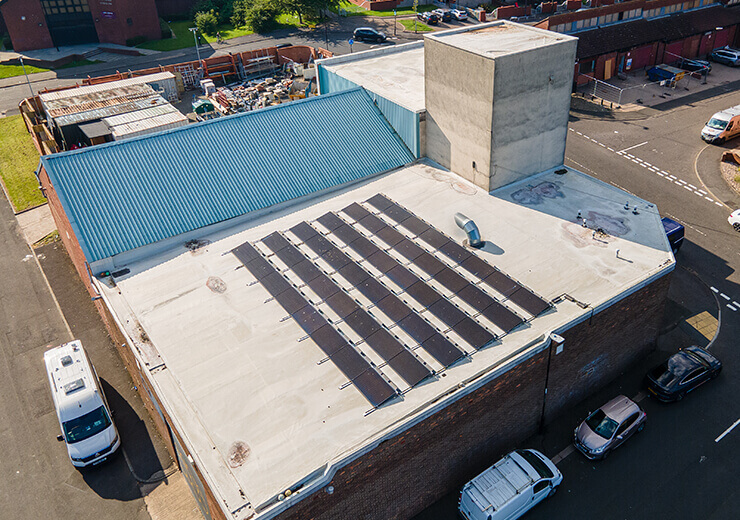
The same 25+ year module expectation can apply to commercial arrays, but the maintenance plan should be more formal because the system is larger and often business-critical. Roof warranties, fire access, planned electrical testing, inverter strategy and downtime all influence lifecycle cost.
For commercial solar systems, we therefore consider replacement strategy and future roof work at design stage, not only when equipment is old.
Our View: Solar Panels Do Not Have a Single Expiry Date
The useful answer is not “25 years and then replace them”. It is “expect decades of service, monitor degradation, maintain the wider system and replace components when condition, safety and economics justify it”. That approach makes better use of a long-life asset.
When Should an Older System Be Inspected?
Arrange professional assessment if generation has fallen unexpectedly, the inverter reports recurring faults, panels show visible damage, the roof needs work or the system has little maintenance history. Older arrays can also benefit from review before a property sale or major electrical upgrade.
If you need us to assess whether an existing system is still worth keeping, contact Sustainable Energy Engineering. We can look at condition and performance rather than replacing equipment purely because of age.
When Does an Older Solar Array Actually Need Replacing?
Age on its own is not a reason to remove a working solar array. If the modules are secure, electrically safe and still producing useful energy, keeping them in service can make more sense than replacing equipment simply because it has reached a particular birthday. A replacement decision is normally driven by a combination of measured output, equipment condition, warranty position, roof plans and the economics of upgrading.
For example, if major roof work is already planned, it can be sensible to assess the remaining value of an older array before paying to remove and reinstall it. Equally, a system with healthy modules but an ageing inverter may only need the inverter or another failed component replaced. We look at the system as a whole so customers can distinguish normal long-term degradation from a genuine end-of-life problem.