
How Efficient Are Solar Panels?
Author: Steve Fairless
Originally Published: 5th January 2024 · Updated: 29th August 2026
Solar-panel efficiency tells you what percentage of the solar energy falling on a module is converted into electrical power under defined test conditions. For modern residential products, high-quality modules are now commonly in the low-20% range. As one current example, REC's Alpha Pure-R reaches 22.3% panel efficiency. That does not mean every panel is 22.3%, and it does not mean a 22.3%-efficient panel will always produce 22.3% more annual energy than another product.
At Sustainable Energy Engineering, we use efficiency as one design input, not as the entire buying decision. Roof area, orientation, shading, module power, inverter design, temperature, system losses and electricity use all influence the final result.
Updated: 29th August 2026 using current DOE, IEA PVPS, MCS, PVGIS and manufacturer data.
Solar Efficiency: The Short Answer
- Module efficiency is the share of incoming solar energy converted into electricity under standard test conditions.
- Strong modern residential modules are now commonly around the low-20% range; REC currently lists 22.3% for Alpha Pure-R.
- Higher efficiency is most valuable when roof area is limited.
- A lower-efficiency panel can still be an excellent choice if the roof has plenty of space and the complete system offers better value.
- Annual kWh matters more than a single efficiency percentage when assessing savings.
What Does 22% Solar Panel Efficiency Mean?
If a module is 22% efficient under its rated test conditions, roughly 22% of the solar energy striking the module surface is converted into electrical output at the module terminals. The rest is reflected, transmitted, converted to heat or lost through fundamental semiconductor processes.
The US Department of Energy identifies wavelength, recombination, temperature and reflection as key factors that limit photovoltaic conversion efficiency. That is why no conventional panel turns all incoming sunlight into electricity.
Efficiency Is Not the Same as Panel Wattage
A 450W panel is not automatically more efficient than a 430W panel. The higher-wattage module may simply be physically larger. Efficiency answers a different question: how much power does the panel produce per unit of area under standard test conditions?
This distinction matters on domestic roofs. If space is tight around chimneys, dormers and roof edges, a more efficient module can fit more installed kWp into the same usable area. If roof space is abundant, cost per installed watt and whole-system performance may matter more.
| Metric | What it measures | Why it matters |
|---|---|---|
| Module efficiency (%) | Conversion of sunlight to electricity per unit area under test conditions | Important when usable roof area is constrained |
| Module power (W) | Rated peak power of one module | Helps determine system capacity |
| Annual yield (kWh) | Energy generated across real weather and seasons | Drives bill savings, self-consumption and export |
Current Product Example: 22.3%
REC currently lists the Alpha Pure-R at up to 430W and 22.3% panel efficiency. We use this only as a current-market example. It should not be read as an industry average, a recommendation for every roof or a claim that efficiency alone makes it the best panel.
There are current products above and below that level. The right module depends on roof geometry, system cost, electrical characteristics, warranty, supply chain and the design objective.
Solar Technology Is Still Improving
Global Technology Shift: N-Type and Bifacial Modules
IEA PVPS's 2025 trends report says n-type technologies represented about 70% of global production and bifacial modules made up more than 75% of production. It also reports that crystalline-silicon modules accounted for roughly 98% of global module production in 2024.
Those figures matter because efficiency improvements are not just laboratory curiosities; the dominant commercial technology mix is changing rapidly.
Why N-Type Technology Matters
N-type is a broad family rather than one single panel design. Current products may use TOPCon, heterojunction or back-contact architectures. These technologies can reduce certain electrical and recombination losses and have helped commercial modules move beyond older efficiency ranges.
For a customer, the label matters less than the result. We compare the exact datasheet, module dimensions, temperature coefficient, electrical limits, degradation warranty and how the product fits the roof.
Temperature: Panels Need Light, Not Heat
The Department of Energy notes that solar cells generally work best at lower temperatures. As cell temperature rises, current increases slightly but voltage falls more significantly, so conversion efficiency usually reduces.
That is why a cool bright UK day can produce very strong power. It is also why panel temperature coefficients belong in a serious design. A module's headline efficiency is measured under controlled conditions; real roof temperatures vary substantially.
Does Cloud Reduce Panel Efficiency?
Cloud primarily reduces the amount of solar irradiance reaching the module. That is different from saying the module itself has suddenly become a lower-efficiency product. In low irradiance, the electrical operating point and system losses change, so real conversion performance can also shift, but the most visible effect is simply less incoming solar energy.
PVGIS uses long-term solar-resource data to model expected energy yield by location, orientation and system configuration. That is more useful for a homeowner than assuming that a 22% module will generate the same energy in every part of the UK.
Shading Can Matter More Than a 1% Efficiency Difference
A customer may spend heavily to move from, for example, a 21% to a 22% module but lose much more energy if the array is badly positioned behind a chimney or tree. MCS performance estimates account for the installed system and shading because layout quality can dominate small module-level differences.
Do Not Buy Solar by Efficiency Percentage Alone
A 23% panel on a badly designed roof is not automatically better than a 21.5% panel in a well-designed array. Compare installed kWp, annual generation estimate, shading, inverter design, warranty, price and usable roof area together.
How Much Difference Does 1 Percentage Point Make?
For panels with the same physical area, moving from 21% to 22% efficiency is about a 4.8% relative increase in rated conversion efficiency, because 22 is 4.8% higher than 21. That can matter on a constrained roof.
But if the 22% panel is also larger, or if the array layout changes, the real installed-capacity difference may be smaller or larger. The correct comparison is the completed roof design, not two percentages in isolation.
Illustrative Efficiency Scale
Illustrative mathematics only: this compares conversion-efficiency percentages for equal module area. It is not a statement that a real 24% system will generate 20% more annual energy than every real 20% system.
Efficiency vs Energy Density
Power density, often expressed in watts per square metre, can be a practical roof-design metric because it combines module power and area. A high-efficiency module usually offers stronger power density, which can be valuable on smaller roofs.
For domestic solar installations, we often care more about how much kWp fits cleanly around roof obstacles than whether one technology has a slightly higher laboratory percentage.
Does Bifacial Mean More Efficient?
Bifacial modules can generate from light reaching the rear surface as well as the front. That can increase energy yield in the right installation, but it is not the same thing as front-side module efficiency. On a flush-mounted dark domestic roof, rear-side gain may be limited. On a reflective flat or ground-mounted site, it may be more useful.
IEA PVPS reports that bifacial modules now dominate a large share of global production, but the actual benefit remains installation-specific.
What About Commercial Solar?
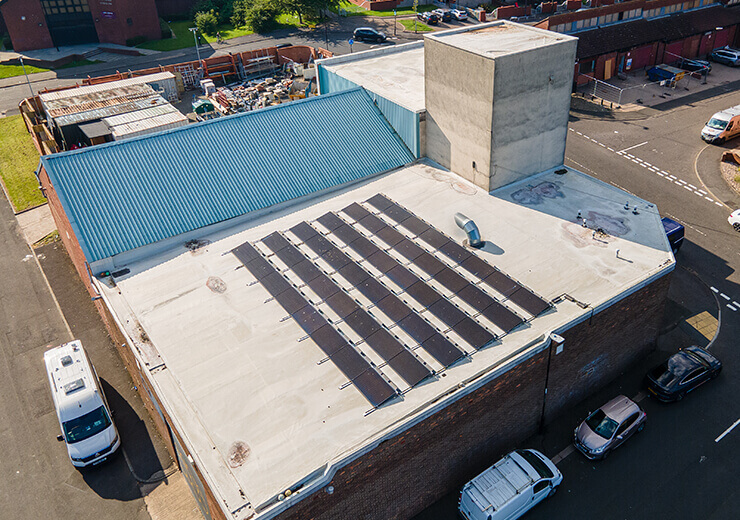
Commercial roofs change the optimisation. A warehouse may have enough area that absolute efficiency is less important than price per watt, structural load, fire access, inverter topology and lifetime yield. Another building may have a small roof but very high daytime demand, making higher-efficiency modules more valuable.
For commercial solar PV, we compare module efficiency with roof utilisation, structural limits and self-consumption rather than treating the highest number as the automatic winner.
How MCS Converts Module Performance into an Annual Estimate
The current MCS solar standard requires the customer to receive a performance estimate based on the installed system. That is important because module efficiency is only one step between sunlight and annual usable electricity.
Real annual output is influenced by:
Whole-System Factors
- postcode solar resource;
- roof orientation and inclination;
- shading;
- installed kWp;
- inverter operating range;
- temperature;
- cable and conversion losses;
- soiling and availability;
- export limitation or clipping where applicable.
Is the Most Efficient Panel Always Worth the Extra Cost?
No. If roof area is the limiting resource, paying more for high efficiency can be rational. If the roof has plenty of space, a slightly lower-efficiency module may produce the same required system capacity at a lower total cost.
We therefore compare the price of the complete installed system against expected annual energy and warranty support. A premium efficiency percentage only earns its keep when it improves the actual design.
Our View: Annual Energy per Pound and per Square Metre Matter More
Efficiency is valuable, especially on constrained roofs, but it is not a quality score for the whole system. The best design is the one that turns the available roof and solar resource into reliable annual kWh at a sensible lifetime cost.
How to Compare Panels Properly
Ask for the exact module datasheet and compare efficiency, dimensions, power, temperature coefficient, warranty, degradation terms and manufacturer support. Then ask how many modules fit your roof and what annual generation the finished array is expected to deliver.
If you want a roof-specific comparison, request a solar design and quotation. We can show whether higher efficiency changes the actual system size or only the brochure headline.