
East-West vs South-Facing Solar Panels: Which Produces More Energy?
Author: Steve Fairless
Originally Published: 19th August 2026 · Updated: 2nd September 2026
A south-facing solar array will normally produce more annual energy per panel than an equivalent east-west array with the same pitch and no shade, but east-west solar can produce a broader daily generation profile and can make better use of roofs that have large east and west slopes. For many UK homes, that wider morning-to-evening output can be extremely useful because electricity is valuable when you can use it, store it or export it at the right time.
At Sustainable Energy Engineering, we do not reject a roof because it is not due south. We model each roof plane separately and compare annual yield, time-of-day generation, usable panel area, household demand and battery strategy.
This guide explains the annual-yield trade-off, why east-west systems can be excellent for self-consumption, how inverter sizing changes when peaks do not coincide, and why the best orientation is often the orientation your building actually gives you.
East-West vs South-Facing Solar: The Short Answer
- South-facing usually wins on annual kWh per panel. It receives stronger solar exposure around the middle of the day.
- East-west spreads production. East modules lead in the morning; west modules carry generation later into the afternoon and evening.
- More usable roof can outweigh lower yield per panel. Two large roof slopes may fit far more panels than one smaller south-facing plane.
- Self-consumption can improve. A broader profile can overlap with breakfast and evening loads better than a sharp midday peak.
- Battery value changes the comparison. A battery can capture a south-facing midday surplus, while east-west may reduce how much shifting is needed.
- There is no orientation-only winner. Shade, pitch, tariff, panel count and household demand all matter.
Why South-Facing Panels Usually Produce More Per Panel
In the UK, the sun spends the middle of the day in the southern part of the sky. A south-facing tilted module therefore receives sunlight at a more favourable angle for more of the high-irradiance part of the day. This tends to maximise annual energy from a fixed number of modules.
That does not mean south-facing panels operate at full power all day. Cloud, temperature, season, sun angle, local horizon and system losses still shape output. It simply means the geometry is generally favourable for annual yield.
Why East-West Solar Can Be More Useful Than the Annual Total Suggests
East-facing modules start strongly earlier. West-facing modules retain stronger output later. When the two arrays are combined, the total power curve is wider and flatter than a comparable south-facing system.
A wider curve can coincide with normal household routines. Morning solar can support showers, kettles, heat pumps and breakfast loads; west-facing generation can extend into the period when cooking, laundry, EV charging or evening occupancy increases.
Illustrative Daily Generation Shape
The chart below is a normalised design illustration, not a site forecast. It shows why equal annual kWh can have different value depending on when the energy arrives.
Current UK Modelling Treats Orientation as a Time-Series Problem
The UK Government's Home Energy Model technical paper for PV generation, published in 2026, calculates PV output using time-step solar irradiation and explicitly makes output dependent on location, orientation, tilt and shading. It also allows more than one array with different characteristics and sums their generation at each time step. The same technical paper notes that an east-west setup can increase PV output at peak times of day in appropriate configurations.
That Is the Key Design Point
East-west is not simply "south minus a percentage". The shape of the generation profile changes. That affects self-consumption, battery charging, export and inverter loading, so we evaluate energy through time rather than only comparing annual totals.
Source: Department for Energy Security and Net Zero, Home Energy Model Technical Paper 18: PV electricity generation and self-consumption, 2026.
South vs East-West: What Changes in Practice?
| Factor | South-facing | East-west |
|---|---|---|
| Annual yield per identical panel | Usually higher. | Usually lower on each individual roof plane. |
| Morning production | Builds towards midday. | East array can be strong earlier. |
| Midday peak | Higher and more concentrated. | Usually broader and lower because east and west peaks are separated. |
| Late-afternoon production | Falls as sun moves west. | West array extends useful output later. |
| Roof utilisation | Depends on the size of the south slope. | Can use both major roof slopes, sometimes allowing materially more panels. |
| Self-consumption | Excellent where daytime loads or battery charging absorb the midday peak. | Can align naturally with morning and evening household demand. |
| Inverter loading | More coincident array peak. | Non-coincident east/west peaks can support a different DC-to-AC design. |
More Panels Can Beat Better Orientation
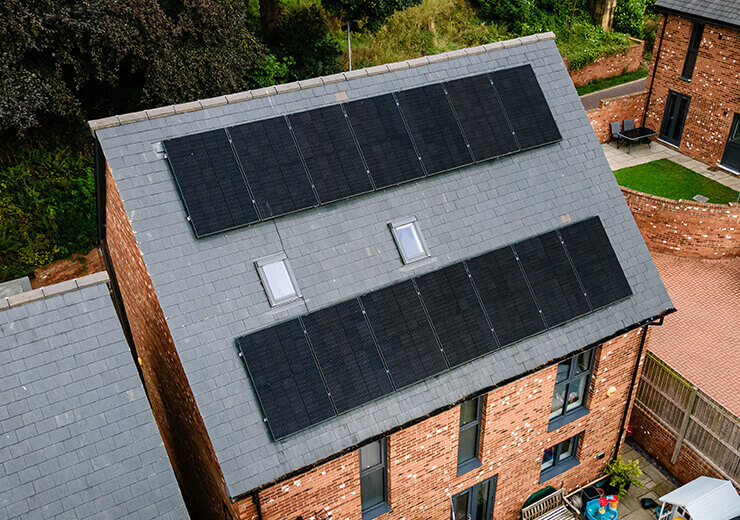
Suppose a home can fit six modules on its south roof but twelve modules across a large east-west roof. The south modules may each generate more, yet the east-west system can still produce much more total electricity because it has twice the panel capacity.
This is one reason roof area and geometry matter as much as compass direction. We design solar PV for the home by looking for the best whole-roof energy result, not by preserving an empty west roof just because south is theoretically optimal.
East-West Solar and Self-Consumption
Self-consumption is the proportion of solar generation used directly in the property rather than exported. A south-facing array can create a strong midday surplus when the house is quiet. An east-west array can lower that midday spike and move more generation towards typical occupancy periods.
Whether that is financially better depends on import price, export tariff and controllable loads. If export is well paid, midday surplus may still be valuable. If imported electricity is much more expensive than export revenue, increasing direct use can be important.
How a Battery Changes the Orientation Question
A battery can reduce the disadvantage of a concentrated south-facing production curve by storing midday surplus for evening use. Conversely, east-west solar can reduce the size of the midday surplus that the battery needs to absorb and can extend direct solar use before and after the battery's main charging period.
For solar PV with battery storage, we simulate the PV curve and household demand together. The best array orientation can change depending on battery size, charge rate, overnight tariff and whether evening export is part of the strategy.
East-West Arrays Can Change Inverter Sizing
Because the two roof faces peak at different times, the combined DC nameplate capacity can be larger relative to the inverter AC rating without the same level of coincident peak power as one equally sized south-facing array. This can improve inverter utilisation across the day.
That does not mean every east-west system should use a small inverter. Voltage, current, MPPT allocation, manufacturer limits and modelled clipping still decide the correct equipment.
Separate MPPTs Matter
East and west strings should normally be allowed to track their own electrical operating points. A modern inverter with suitable independent MPPT inputs can do this effectively when each roof face has enough compatible modules for valid strings.
On highly fragmented roofs, module-level electronics can offer additional flexibility, but a clean two-orientation east-west roof often does not require an optimiser on every panel simply because the directions differ.
What About South-East and South-West?
These are often excellent orientations because they retain much of the annual-yield advantage of southerly exposure while shifting some production earlier or later. A roof split south-east/south-west can provide a particularly useful broad curve without moving as far from south as due east and due west.
Again, roof pitch and local shade can change the result more than a small compass difference. A clear south-west roof can outperform a theoretically better south roof blocked by a large tree.
Flat-Roof East-West Layouts Are a Different Design Case
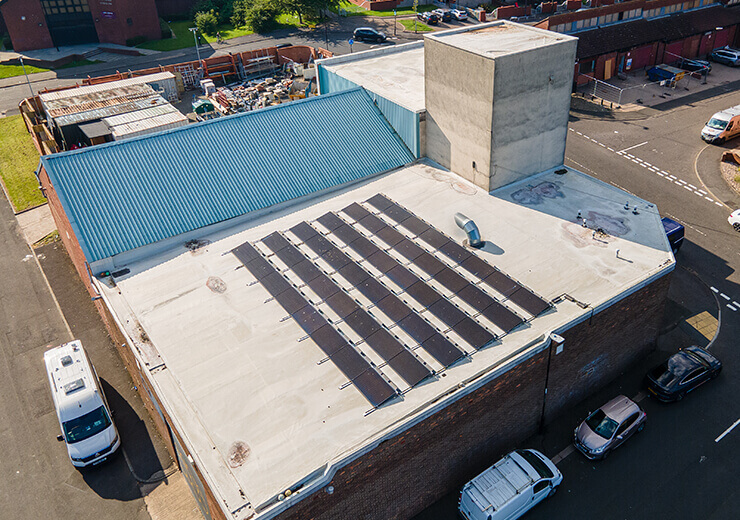
On flat roofs, east-west mounting is often used at relatively low tilt so opposing rows can be packed efficiently with reduced inter-row shading compared with steep south-facing rows. This can increase installed kWp per square metre of roof, especially on commercial buildings.
The structural and aerodynamic design becomes central: ballast or fixings, wind zones, drainage routes, roof membrane loading, access and fire considerations must all be addressed. Orientation is only one part of the engineering.
How PVGIS Supports Orientation-Specific Design
The European Commission Joint Research Centre's PVGIS service calculates monthly and annual PV output using a selected location, slope and azimuth. The current PVGIS 5.3 production release uses updated solar datasets through 2023 for relevant European coverage, and the newer PVGIS 6 beta uses underlying data through 2024. We use this kind of location-specific modelling principle rather than relying on a national one-size-fits-all percentage.
Source: European Commission Joint Research Centre, PVGIS 5.3 and PVGIS 6 documentation, checked September 2026.
Shading Can Reverse the Expected Winner
Orientation comparisons assume similar shade. In reality, a south roof can be damaged by a chimney, tree or neighbouring building while an east or west roof is open to the sky. The unshaded east-west design may then be the better generator despite the compass direction.
We model obstructions on each roof plane and avoid quoting a generic east-west penalty before the actual shading picture is understood.
Which Is Better for an EV or Heat Pump?
It depends on when the load runs. A heat pump that works through the day may use a south-facing peak very well. An EV charged after work may benefit more from a west-facing extension, although a battery or smart charging schedule can shift energy again.
The most valuable design combines the generation profile with flexible loads. Orientation is not just a solar question; it is an energy-management question.
Our Orientation Design Checklist
What We Compare Before Choosing the Layout
- Usable panel count on each roof face.
- Pitch and exact azimuth, not a rough compass label.
- Seasonal and hourly shading.
- Predicted annual generation for each sub-array.
- Morning, midday and evening household demand.
- Battery capacity and charge/discharge rate.
- Import and export tariff structure.
- MPPT allocation and inverter clipping.
- Roof access, edge zones and mounting practicality.
- Future EV, heat-pump or electrical-load plans.
Annual kWh and Useful kWh Are Not the Same Question
Two arrays can have similar annual generation yet deliver that energy at different times. A south-facing array often has a stronger midday concentration. An east-west system spreads more of its output toward the morning and afternoon. For a household, the second profile can sometimes align better with breakfast loads, home working, afternoon appliances or early-evening demand.
That timing changes the value of the electricity. A kilowatt-hour used directly in the property avoids buying that unit from the grid. A kilowatt-hour exported is valued at the export tariff. A kilowatt-hour stored in a battery can be shifted to later, but it passes through battery and inverter losses. We therefore model not only annual generation but also when that generation is likely to be available.
Seasonal Performance Can Change the Orientation Preference
The sun's path is much higher and longer in summer than in winter. In the brighter months, east- and west-facing roofs can receive useful sunlight across long parts of the day. In winter, lower solar elevation and shorter days make orientation, roof pitch and horizon shading more influential, and all domestic arrays produce less energy than in summer.
Do Not Judge Orientation From One Summer Day
A clear June graph can make almost any unshaded orientation look impressive. We are interested in the whole-year energy profile and, where the customer's objective is bill reduction, the way that profile overlaps with household demand across different seasons.
East-West Can Reduce the Midday Power Peak for the Same Array Capacity
When half an array faces east and half west, the two roof planes tend to reach their strongest output at different times. Their combined power curve can therefore be broader and flatter than an equivalent south-facing array. This can reduce the amount of time the whole array is simultaneously close to its theoretical peak.
That characteristic can be useful for inverter design and export management. It may allow a larger DC array to be connected to an appropriately specified inverter without creating the same coincident midday peak that would be expected if every module faced the same optimum direction. The exact acceptable DC-to-AC ratio remains a manufacturer- and model-specific calculation.
Roof Area Often Matters More Than Compass Direction
Illustrative Capacity Comparison
Imagine one home has room for only 8 panels on its south roof, while another layout can use 14 comparable panels split east and west. Even if each east-west panel produces less energy over the year, the larger installed capacity may give the east-west design a higher total annual yield.
| Illustrative layout | Number of panels | Relative yield per panel | What determines the winner? |
|---|---|---|---|
| Small south roof | 8 | Higher | Excellent individual panel yield but limited usable area. |
| Larger east-west roofs | 14 | Lower | More total collector area may outweigh the orientation penalty. |
This is an illustration, not a production forecast. We use site-specific modelling for the actual address, module size, pitch, horizon and shading before comparing annual kWh.
How Orientation Affects Battery Sizing
A battery should be sized against the surplus that actually exists, not against panel capacity alone. A concentrated south-facing array may create a larger midday surplus that needs storing if daytime consumption is low. A broader east-west profile can increase direct consumption and reduce the size of the midday surplus, although a larger east-west array may still generate substantial excess energy in summer.
For this reason, we review PV orientation and battery size together. A battery selected from a generic "kilowatt-hours per kWp" rule can be too large or too small once the real generation and household demand profiles are considered.
What We Compare in the Design Software
Orientation Is Only One Input
- annual irradiation and modelled generation for each roof plane;
- roof pitch, azimuth and usable module count;
- near and horizon shading throughout the year;
- separate MPPT/string requirements for different orientations;
- the combined hourly power profile and likely inverter clipping;
- daytime household demand and expected self-consumption;
- battery charge window, usable capacity and discharge needs; and
- export limits or tariff strategy where they materially affect the design.
Bottom Line: South Wins Per Panel, East-West Can Win for the Property
If two identical arrays have the same pitch, shade and panel count, south-facing normally produces more annual energy in the UK. But homes are not laboratory comparisons. East-west roofs can hold more panels, spread generation across more of the day and align extremely well with real electricity demand.
How We Use the 15–20% East/West Figure in a Real Design
Energy Saving Trust’s current guidance says an east- or west-facing solar system tends to generate around 15–20% less electricity than one facing directly south. We use that as a useful national benchmark for an equal-size comparison, not as a fixed loss that should be applied blindly to every property.
The 2026 Home Energy Model PV methodology supports that approach. It makes generation dependent on location, orientation, tilt and shading, allows more than one array with different characteristics, and sums their generation at each timestep. It also links self-consumption to whether household demand occurs at the same time as PV generation.
| Evidence | What it tells us | How we use it |
|---|---|---|
| 15–20% east/west benchmark | Equal-sized east or west arrays will usually produce less annual energy than an equivalent due-south array. | We use it as a sense-check before calculating the actual roof-specific yield. |
| Time-step modelling | Morning, midday and late-day generation have different value depending on when the home uses electricity. | We compare the daily generation shape, not only annual kWh. |
| Multiple roof planes | Two usable east-west slopes can provide substantially more installable kWp than one smaller south-facing slope. | We compare total usable array capacity as well as yield per panel. |
Our design decision is therefore based on the whole property. If south and east-west roofs can take the same number of panels, south will normally lead on annual kWh. If east and west provide much more usable roof area or a better match to household demand, the east-west design can still be the stronger system overall.
Evidence used: Energy Saving Trust, current solar-panel guidance; Department for Energy Security and Net Zero, HEM-TP-18 v3.0, January 2026. Both references were rechecked on 2nd September 2026.
Have an East-West Roof?
We can model both roof faces and compare generation, self-consumption and storage before recommending a layout. request a solar quote and we will design around the roof you actually have.