
Do Solar Panels Work in the Shade?
Author: Steve Fairless Originally Published: 10th August 2026 · Updated: 2nd September 2026
Yes, solar panels can still generate electricity in shade because photovoltaic cells respond to available light, including diffuse daylight. However, shade reduces the irradiance reaching the cells, so output falls and the electrical effect can be more complicated than simply losing the percentage of panel area that looks shaded. The result depends on where the shadow falls, how long it remains, module design, bypass-diode behaviour, string layout, MPPT configuration and whether module-level electronics are used.
At Sustainable Energy Engineering, we do not treat shading as a yes-or-no question. We model it as part of the array design. Sometimes the correct answer is to move one or two modules. Sometimes it is to split roof orientations across separate MPPTs. In other cases, a module-level solution can be justified. The important point is that hardware should support a good layout, not disguise a poor one.
This guide explains what shade actually does to a solar array, why winter and summer shadows can be very different, what optimisers can and cannot fix, and how we decide whether a shaded roof still makes financial and engineering sense.
Updated: 2nd September 2026. Evidence and technical references checked against current published guidance.
Do Solar Panels Work in Shade? The Short Answer
- They still work, but with less available light they produce less power. Shade is a loss mechanism, not an automatic shutdown.
- Partial shade can be electrically disproportionate. A shadow crossing a cell group can change the operating point of a module or string and activate bypass diodes.
- Shade changes through the year. A chimney shadow that is small at midday in June can stretch across several modules when the sun is lower in winter.
- Good layout comes before optimisers. Moving modules away from a persistent obstruction can be more reliable and cost-effective than adding electronics to every panel.
- Optimisers are not an automatic yield upgrade. Independent IEA PVPS analysis shows that lightly to moderately shaded systems can have only small annual differences between conventional string-inverter and optimiser approaches.
- A realistic performance estimate must include shading. We should not quote an unshaded annual yield for a roof that has material obstructions.
Shade, Cloud and Low Light Are Not the Same Thing
Cloud cover reduces solar irradiance over a wide area. A local shadow is different: a tree, chimney, dormer, aerial, neighbouring roof or parapet blocks direct light from a specific part of the array. The shaded module may still receive diffuse light from the sky, but its electrical operating conditions can differ substantially from modules in full sun.
This distinction explains why a cloudy day can still produce a smooth, useful generation curve while a sharp local shadow can create a more complex pattern. The inverter is trying to find the maximum power point of an array whose modules may not all be receiving the same irradiance.
What Happens Electrically When Part of a Solar Panel Is Shaded?
Modern crystalline-silicon modules contain many cells connected in series and normally include bypass diodes across groups of cells. Current in a series path is constrained by the weakest operating section. When a cell group is sufficiently shaded, a bypass diode can conduct and route current around that section, reducing the module voltage but allowing the rest of the string to continue producing.
This is why the visual area of a shadow does not translate directly into the same percentage power loss. The location and orientation of the shadow relative to cell strings and bypass-diode groups can matter as much as the total shaded area.
Important: "10% Shaded" Does Not Always Mean "10% Less Power"
A narrow shadow across a critical cell group can have a different electrical effect from a soft shadow covering a larger area. We therefore model the obstruction and design around it rather than applying a crude percentage reduction to the whole array.
Common Sources of Shade on UK Roofs
| Shade source | How the shade behaves | Design response we consider |
|---|---|---|
| Chimney | Sharp, moving shadow that can cross a small number of modules during part of the day. | Move modules, leave a clear zone, split strings or use module-level electronics only where justified. |
| Dormer or roof projection | Predictable geometric shade, often strongest when the sun is low. | Use 3D layout and seasonal sun-path modelling before placing modules close to the obstruction. |
| Tree | Can be diffuse or dense, seasonal or year-round, and may change as the tree grows. | Model current and future canopy; consider lawful tree management where appropriate and never base a design on an assumed future removal. |
| Neighbouring building | Large repeatable shadow, often significant in winter or on lower roof planes. | Model hour-by-hour geometry; exclude persistently poor roof zones if their contribution is weak. |
| Aerial or flue | Small but sometimes sharp shadow that moves across modules. | Reposition where practical or place modules to reduce the duration of direct shading. |
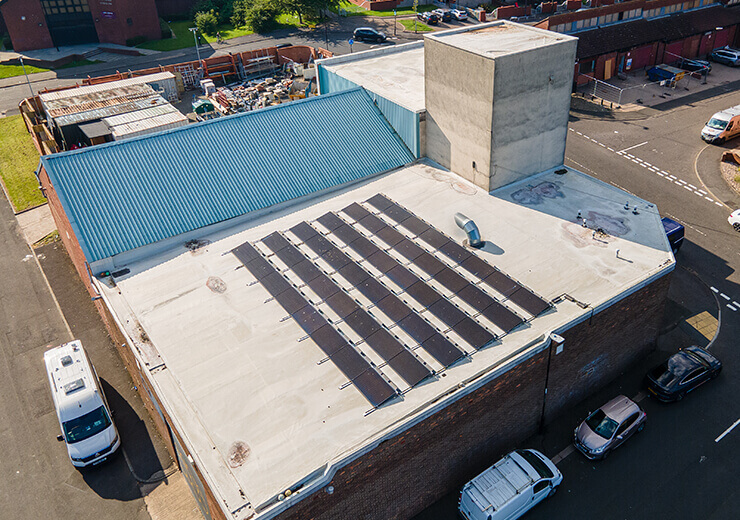
| Parapet or roof edge | Important on flat roofs where low sun can cast long shadows across rows. | Increase row spacing, alter tilt or reduce row count to protect annual yield. |
| Another solar row | Self-shading created by the array design itself. | Set row pitch and tilt from winter sun geometry rather than maximising module density. |
Why Winter Shade Can Be Much Worse Than Summer Shade
The sun is lower in the sky during winter, so objects cast longer shadows. A chimney or tree that barely affects an array in June can cover a much larger area in December. Shorter days also mean each shaded hour represents a larger share of the available solar window.
That is why we do not assess shade from a single site visit at one time of day. Survey observations are combined with geometry and performance modelling. A bright summer afternoon can make a roof look almost perfect even when winter shade materially changes the annual result.
How MCS Performance Estimates Treat Shading
Current MCS solar PV performance-estimation methodology requires the annual generation calculation to account for the location, installed capacity, orientation, inclination and a shade factor. This matters because the customer should see an estimate that reflects the actual roof rather than a theoretical unshaded system.
MCS also makes clear that predicted output is an estimate, not a guarantee. Weather changes from year to year and remote measurements of pitch, orientation or shading can differ from what is found during a detailed survey.
What the Performance Estimate Should Tell You
A useful proposal should make it possible to distinguish the unshaded potential of the array from the effect of known shading. If a roof has a chimney, dormer or tree line, the performance model should not quietly assume clear sky access.
Source: MCS 032:2025, Solar PV performance-estimation and customer information requirements.
String Inverters, MPPTs and Why Array Grouping Matters
A string inverter can have one or more Maximum Power Point Trackers (MPPTs). Each tracker adjusts the operating voltage and current to find a high-power operating point for the connected modules. If panels with very different orientations or shading conditions are placed on the same tracker without good reason, the inverter has a harder electrical problem to solve.
We normally group modules so that panels sharing an MPPT have compatible operating conditions. An east-facing roof and a west-facing roof may be placed on separate trackers. A small shaded group may be isolated from a clear group where the inverter and voltage window allow it.
This is one reason a bespoke home solar PV design matters more than simply counting panels. Two arrays using the same module can perform differently because their string and MPPT design is different.
Do Solar Optimisers Solve Shading?
Optimisers can allow module-level power control and monitoring and can reduce some mismatch losses. They are useful tools, particularly where roof geometry, safety requirements, module-level monitoring or unavoidable mismatch creates a clear reason for them. But they do not create light where there is none.
A heavily shaded module still has less solar energy available. An optimiser may help prevent its operating condition from constraining other modules in the same way, but the shaded module cannot recover the energy blocked by the obstruction.
Optimisers Are Not a Substitute for Good Layout
If a module is predictably shaded for a large part of the year, the first question should be whether that module belongs there at all. Adding electronics to every panel can add cost, conversion loss and roof-level components that may need service in future.
Independent Research: Optimisers Do Not Always Beat String Inverters
The IEA Photovoltaic Power Systems Programme published a detailed 2024 review of partially shaded PV generators using conventional string inverters and module-level power electronics. One of the most useful conclusions is that optimisers are not automatically the highest-yield solution.
In the lightly to moderately shaded systems that dominate the market, the report found that annual yield differences between optimiser and string-inverter approaches are usually less than 3%. It also reported that realistic optimiser conversion losses can materially affect the comparison, and conventional string inverters can sometimes perform better.
Why "Fit Optimisers Everywhere" Is Too Simple
Source: IEA PVPS Task 13, Performance of Partially Shaded PV Generators Operated by Optimized Power Electronics, 2024. Bars are an editorial illustration of design priority, not measured efficiency percentages.
What About Microinverters?
Microinverters convert DC to AC at each module, so each panel has its own power conversion and tracking. That can be attractive on complex roofs where modules face several directions or where module-level monitoring is important. Like optimisers, however, a microinverter cannot replace missing irradiance and it adds electronics at roof level.
The best choice is a system-level decision involving roof geometry, available products, warranty, maintenance strategy, cable architecture, backup requirements and cost. We do not specify a technology simply because the roof contains one chimney.
How Much Shade Is Too Much for Solar?
There is no universal percentage at which solar suddenly becomes a bad investment. A roof with a small morning shadow may still deliver excellent annual generation. A roof blocked by a neighbouring building through the most productive part of the day may not.
The useful question is: how many kilowatt-hours will the affected modules still produce over a year, and what are those kilowatt-hours worth to the customer? We compare the incremental energy from the shaded part of the array with the extra module, mounting, inverter, labour and future-service cost.
Low, Moving Shade
Often manageable through layout and sensible string design. A small chimney shadow may affect only a limited part of the annual energy window.
Persistent Dense Shade
Can make a roof zone poor value. If an obstruction blocks direct and much of the diffuse sky view for long periods, removing modules from that zone may be the better design.
Can a Battery Compensate for Shade?
A battery can move solar energy from one time of day to another, but it cannot replace generation that never occurred. If shading cuts the array's annual output, the battery has less solar energy available to store.
What storage can do is increase the value of the solar energy that is produced. For a home with good midday generation but high evening demand, solar PV with battery storage can move daytime surplus into the evening. That is a different problem from shading and should be modelled separately.
Does Shade Cause Hotspots?
Persistent cell-level mismatch can contribute to localised heating. Modern modules use bypass diodes and are tested to manage expected operating conditions, but array design should still avoid known severe shading where possible. Leaves, bird fouling and other localised contamination can also create mismatch, which is another reason performance monitoring and occasional visual inspection are valuable.
Trees: The Most Difficult Shade Source to Predict
Trees are dynamic. Leaves appear and fall, branches move, canopies grow and the sun path changes. A deciduous tree may create dense summer shade but much less obstruction in winter after leaf fall; an evergreen can behave differently. We do not build a performance estimate on the assumption that a tree will be removed unless that is a confirmed and lawful part of the project.
Where tree work is proposed, ownership, conservation status and local restrictions must be resolved separately from the solar design. The safest performance model is based on the physical conditions that can reasonably be expected to remain.
Flat-Roof Self-Shading: When the Solar Array Shades Itself
On a flat roof, one row of tilted modules can cast a shadow on the row behind it. Increasing the tilt can improve the angle to the sun but also lengthen the row shadow and reduce the number of modules that fit. Reducing tilt can fit more modules and reduce row spacing, but changes the generation profile and soiling behaviour.
There is no universal best row spacing. We model the geometry, roof area, parapets and annual energy trade-off instead of maximising panel count.
Our Shading Design Checklist
How We Reduce Avoidable Shading Losses
- Map the obstruction. Identify its height, position and whether it is permanent or likely to change.
- Check the sun path. Consider seasonal solar altitude, not just the shadow visible during the survey.
- Protect the best roof zones. Put modules where solar access is strongest before filling marginal areas.
- Group modules intelligently. Keep different orientations and shading conditions on appropriate MPPTs where possible.
- Check voltage windows. A string still needs sufficient voltage across expected temperatures and operating conditions.
- Model the annual effect. Include shade in the performance estimate rather than adding a vague allowance.
- Use module-level electronics for a reason. Specify optimisers or microinverters when the benefit is clear, not as a universal sales feature.
- Plan monitoring. Make it possible to distinguish normal seasonal effects from a fault or new obstruction.
How to Tell Whether Shade Is Already Affecting an Existing System
Monitoring can reveal repeatable dips at the same time each clear day, unexpectedly weak strings, or a seasonal pattern that corresponds with vegetation or a neighbouring structure. It can also prevent shading from being blamed for an electrical fault, inverter clipping, module failure or connectivity problem.
If output has fallen compared with previous years, we look for changes: a tree has grown, a new building or aerial has appeared, panels are soiled, an optimiser has failed, or the problem is unrelated to shade. Diagnosis should start with data rather than assumptions.
Do Shaded Roofs Still Make Financial Sense?
Many do. The answer depends on the annual energy loss and how much of the remaining generation the property can use or export. A partially shaded array that still produces a large amount of useful electricity can be a strong investment. A marginal roof zone that adds expensive hardware for very little energy may not be.
We prefer to show the customer the trade-off. If removing two shaded modules only reduces annual generation slightly but simplifies the design, that can improve value. If module-level control allows a complex but productive roof to be used effectively, the additional cost may be justified.
How We Decide Whether Shade Needs Extra Hardware — or a Better Layout
We start by quantifying the annual loss, not by assuming an optimiser is the answer. MCS 032 requires shading to be reflected in the performance estimate, so we compare the roof’s unshaded potential with the expected output after real obstructions and seasonal sun angles are included.
NREL’s legacy light-, moderate- and heavy-shade cases showed different relative benefits from module-level electronics, while the later IEA PVPS analysis shows that optimised electronics do not automatically beat a conventional string inverter once the complete system losses are considered. Those studies are useful because they point in the same direction: shade severity and layout matter more than a generic optimiser percentage.
Our order of decisions: move or omit persistently poor modules first; group orientations and shade patterns sensibly across MPPTs second; use module-level electronics where the annual model, monitoring need or roof complexity genuinely justifies them.
Unsure How Much Shade Your Roof Gets?
We can assess the roof geometry, obstructions, string layout and your expected energy use before recommending a system. The aim is an honest annual performance estimate and a design that avoids unnecessary hardware.
Request a tailored solar survey and quote and we will model the roof rather than guess from a photograph.