
Can I Save Money with Solar Panels?
Author: Steve Fairless
Originally Published: 28th March 2024 · Updated: 29th August 2026
Yes. A correctly designed solar PV system can reduce the electricity you buy from the grid and can earn export income for electricity you do not use. The amount saved is not a fixed percentage: it depends on how much the system generates, how much of that generation you use yourself, your import tariff, your export tariff, and whether extra equipment such as a battery improves the economics enough to justify its cost.
At Sustainable Energy Engineering, we prefer to show the calculation rather than promise a headline saving. The numbers below use current August 2026 public data and clearly label any illustrative examples.
Updated: 29th August 2026 using current Energy Saving Trust, Ofgem, HMRC, MCS and UK Government sources.
Current 2026 Solar Savings Benchmarks
- Energy Saving Trust currently uses around £7,600 as the average installed cost of a 4.5kWp home solar system.
- Its current payback examples with export payments are around 9 years in London and Aberystwyth, around 10–11 years in Manchester, and around 11–12 years in Stirling, depending on occupancy.
- Ofgem's average capped electricity unit rate is 26.11p/kWh for July–September 2026 and 26.32p/kWh for October–December 2026 for standard variable direct-debit customers in Great Britain.
- Energy Saving Trust currently uses roughly 12p/kWh as a typical SEG export assumption in its consumer guidance, but actual supplier tariffs vary.
- Qualifying installed solar remains temporarily 0% VAT through 31 March 2027.
Where the Money Actually Comes From
Solar has two main income streams for a typical home: avoided imports and paid exports.
That simple equation is much more useful than saying “solar cuts bills by 70%”, because the percentage changes from one household to another.
What Is a Self-Consumed Unit of Solar Worth Right Now?
For a household paying Ofgem's average capped single-rate electricity price of 26.11p/kWh during July–September 2026, every 1,000kWh of solar electricity that genuinely replaces grid imports is worth about £261 before allowing for tariff differences or system losses.
| Solar electricity used instead of grid power | Value at 26.11p/kWh |
|---|---|
| 500kWh | About £131 |
| 1,000kWh | About £261 |
| 1,500kWh | About £392 |
| 2,000kWh | About £522 |
These are simple arithmetic examples, not quotations or guaranteed savings. Your real tariff may be higher, lower, fixed, time-of-use or otherwise structured differently from the price-cap average.
Why Self-Consumption Usually Matters More Than Export
Energy Saving Trust's current guidance says you might typically receive around 12p for each unit exported through the Smart Export Guarantee, while buying a unit from the grid can cost more than twice that. That gap is why using your own generation can be valuable.
But exporting is not “wasted” electricity. If you cannot use the unit economically, a strong export tariff may be the better outcome. The right design balances both.
Worked Example: 4,000kWh of Annual Solar Generation
Illustrative only. Assume 4,000kWh generation, a 26.11p/kWh avoided import price and a 12p/kWh export tariff.
- At 40% self-consumption: 1,600kWh × 26.11p = about £418 avoided imports.
- The remaining 2,400kWh exported at 12p = about £288.
- Combined annual value = roughly £706 before maintenance, inverter replacement, degradation, finance costs or tariff changes.
This shows why a credible quote must separate generated energy, self-used energy and exported energy.
Would a Battery Increase the Saving?
A battery can move solar electricity from the middle of the day to the evening, increasing the amount used behind the meter. It can also work with time-of-use tariffs. But higher self-consumption does not automatically mean faster payback.
Energy Saving Trust currently puts domestic battery storage at roughly £5,000–£8,000. That extra capital cost has to be compared with the additional value the battery creates.
A Battery Is Not Automatically a Financial Win
If a household already has a strong export tariff, low evening demand or limited annual surplus, the extra savings from a battery may not repay the added cost quickly. Conversely, high evening usage, a large solar surplus and a good time-of-use tariff can make storage much more compelling.
A Second Worked Example: Higher Self-Consumption
Using the same illustrative 4,000kWh annual generation, suppose storage and load shifting increase solar self-consumption from 40% to 70%:
- 2,800kWh used in the home at 26.11p = about £731.
- 1,200kWh exported at 12p = about £144.
- Combined annual value = about £875.
That is roughly £169 more annual value than the 40% self-consumption example. Whether that difference justifies a battery depends on its purchase price, usable capacity, round-trip efficiency, warranty, tariff strategy and how long you expect to remain in the property.
Current Payback Evidence Is More Useful Than Old “5-Year” Claims
Energy Saving Trust's page was updated on 27th August 2026 and currently gives payback estimates with export payments based on July 2026 fuel prices. Its examples are:
| Location | Home all day | Home half the day | Out all day |
|---|---|---|---|
| London | 9 years | 9 years | 9 years |
| Manchester | 10 years | 10 years | 11 years |
| Aberystwyth | 9 years | 9 years | 10 years |
| Stirling | 11 years | 11 years | 12 years |
Those are national modelling examples, not a promise that every property will match them. Roof direction, shade, local solar resource, equipment choice and tariff behaviour can shift the answer materially.
Why a Good Solar Quote Should Include a Generation Estimate
Current MCS MIS 3002 requires an annual generation estimate and, where applicable, an estimate of self-consumption. This is exactly the information needed to model savings properly.
A quote that gives only “10 panels = £800 per year saving” without showing the generation and self-consumption assumptions is difficult to audit. Our domestic solar PV systems are sized around the property and its usage rather than a generic panel count.
What Changes Solar Savings the Most?
| Variable | Why it matters | What to check |
|---|---|---|
| Annual generation | Sets the pool of energy available to save or export. | Postcode, orientation, pitch and shading. |
| Daytime demand | More simultaneous consumption can increase the value per solar kWh. | Work-from-home pattern, appliances, EV and heat pump loads. |
| Import tariff | Higher avoided import prices increase the value of self-consumed solar. | Your actual tariff, not just a national average. |
| Export tariff | Changes the value of surplus power. | Supplier terms, fixed or dynamic rate, eligibility. |
| Battery strategy | Can shift consumption and enable tariff arbitrage. | Battery cost, efficiency, usable capacity and warranty. |
| Capital cost | Directly affects payback. | Whole installed price, not panel-only advertising. |
Does 0% VAT Still Apply?
Yes, for qualifying installations. HMRC's current energy-saving materials guidance shows a temporary zero rate for installed solar panels through 31st March 2027, after which the reduced rate applies under the current rules.
That tax treatment reduces the upfront cost compared with a standard-rated installation, but it is not a grant and should not be added to an ROI calculation as recurring annual income.
How Does the Smart Export Guarantee Work?
Ofgem requires participating SEG suppliers to pay eligible small-scale generators for exported electricity. The rate is set by the supplier and must be above zero. Payments are based on actual export meter readings.
This means the export tariff you choose matters. Two identical PV systems can have different annual financial outcomes simply because the households have different import/export contracts and usage patterns.
What About Commercial Solar Savings?
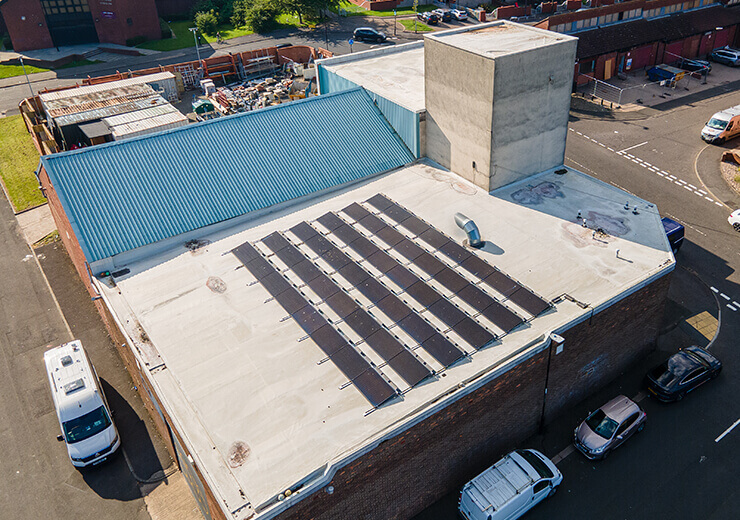
For a business, the calculation often changes because a larger proportion of electricity may be consumed during daylight working hours. That can produce high on-site self-consumption without a battery. Demand profiles, half-hourly data, roof/land availability and tariff structure become central to the business case.
We design commercial solar PV around actual daytime load rather than applying domestic assumptions to a business.
Five Ways to Improve the Financial Outcome
Practical Solar Savings Checklist
- Use recent annual electricity consumption, not a rough monthly direct debit.
- Model generation for the actual roof, postcode and shading.
- Compare the value of self-use with the best export tariff you can realistically access.
- Size a battery around surplus and demand rather than choosing the largest capacity available.
- Include likely inverter/battery replacement or degradation assumptions in long-term modelling.
Is Solar Adoption Still Growing?
Yes. UK Government data published on 27th August 2026 reports nearly 172,000 solar installations since the start of 2026, with rooftop solar accounting for more than seven in ten installations during July. That does not prove solar is financially right for every property, but it does show continuing demand rather than a shrinking technology market.
Our 2026 Answer: Can Solar Save You Money?
Yes, if the system is suitable and the savings assumptions are realistic. Solar has a simple economic advantage: each unit you generate is either used to avoid buying electricity or exported for a payment. The engineering challenge is to maximise the value of those units without overspending on equipment.
For a proper savings assessment, we need annual kWh usage, tariff information and the property layout. You can request a tailored quotation and we will size the system around real demand rather than a generic savings claim.